



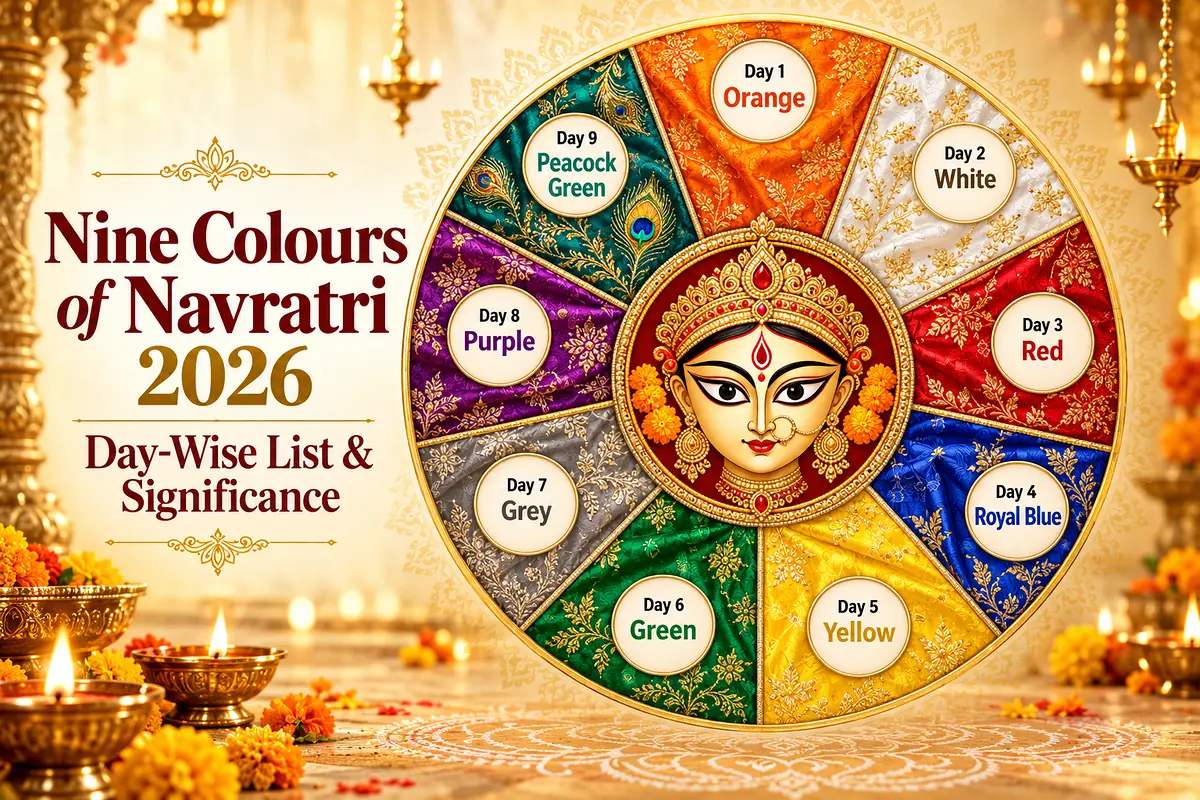
The nine colours of Shardiya Navratri 2026, starting 11 October, are Orange (Day 1, Maa Shailputri), White (Day 2, Maa Brahmacharini), Red (Day 3, Maa Chandraghanta), Royal Blue (Day 4, Maa Kushmanda), Yellow (Day 5, Maa Skandamata), Green (Day 6, Maa Katyayani), Grey (Day 7, Maa Kaalratri), Purple (Day 8, Maa Mahagauri) and Peacock Green (Day 9, Maa Siddhidatri).
Navratri is a time for bright clothes, decorated temples, and lively Garba dancing. A popular custom during the festival, especially the Shardiya Navratri, is wearing a specific colour each day.
Each of the nine days honors a different form of Maa Durga. Many people pick outfits in the day’s suggested colour, and some use them for their Puja decorations too.
The colours for Shardiya Navratri can vary each year. Here’s the colour sequence for the nine days in 2026, along with what each one traditionally means.
Shardiya Navratri 2026 Calendar: Dates, Goddesses and Colours
| Day | Date | Tithi | Goddess | Colour |
|---|---|---|---|---|
| Day 1 | Sunday, 11 Oct 2026 | Pratipada (Ghatasthapana) | Maa Shailputri | Orange |
| Day 2 | Monday, 12 Oct 2026 | Dwitiya | Maa Brahmacharini | White |
| Day 3 | Tuesday, 13 Oct 2026 | Tritiya | Maa Chandraghanta | Red |
| Day 4 | Wednesday, 14 Oct 2026 | Chaturthi | Maa Kushmanda | Royal Blue |
| Day 5 | Thursday, 15 Oct 2026 | Panchami | Maa Skandamata | Yellow |
| Day 6 | Friday, 16 Oct 2026 | Shashthi | Maa Katyayani | Green |
| Day 7 | Saturday, 17 Oct 2026 | Saptami (Maha Saptami) | Maa Kaalratri | Grey |
| – | Sunday, 18 Oct 2026 | Saptami continues; Ashtami begins 08:29 AM | – | – |
| Day 8 | Monday, 19 Oct 2026 | Ashtami (Durga Ashtami) | Maa Mahagauri | Purple |
| Day 9 | Tuesday, 20 Oct 2026 | Navami (Maha Navami) | Maa Siddhidatri | Peacock Green |
| Dussehra | Tuesday, 20 Oct 2026 | Dashami begins 12:51 PM | Vijayadashami | – |
Confused in Life? Consult With our Astrologers and Get First Astrology Call is 100% Free!
Why Do Navratri Colours Change Every Year?
In Maharashtra and some other areas, the nine Navratri colours are usually chosen based on the day of the week the festival starts. Because the date of Shardiya Navratri shifts each year, the order of the colours also changes. That’s why an old list of Navratri colours might not match the current festival.
These are mostly a tradition for the celebration. People can still worship Maa Durga with devotion, no matter what colour clothes they wear.
Day 1 – Orange: Maa Shailaputri
Navratri starts by worshipping Maa Shailaputri, who is known as the daughter of the Himalayas and the first of the Navdurga forms.
For 2026, orange is the colour for the first day. Orange is often seen as representing enthusiasm, warmth, and new beginnings. Many people wear traditional orange clothes to celebrate the start of the festival.
In homes that follow the tradition, the first day is also when Ghatasthapana happens. Families set up their prayer area, place the Kalash, and start their Navratri prayers.
Day 2 – White: Maa Brahmacharini
The second day is for Maa Brahmacharini. The story of the Goddess on the second day is one of a rigorous Prayer of the goddess to Lord Shiva.
White is said to represent purity, simplicity, and peace. The nature of Maa Brahmacharini, who has an innocent, solemn, and peace-loving image, is complemented by her wearing white. Worship of her reminds us to be patient and persistent while working hard towards our goal.
Day 3 – Red: Maa Chandraghanta
During the third day of the puja, the worshipers celebrate Maa Chandraghanta. She is a goddess who has a moon on her forehead and a fierce attitude.
Red is associated with strength, courage, and passion. It was also an ancient colour of goddess worship and was used in the form of a red veil or flowers at the time of the ceremony.
Most of the time, women wear red when they visit temples and also during the Garba dances held during Navratri.
Day 4 – Royal Blue: Maa Kushmanda
On the fourth day, Maa Kushmanda is worshipped, who is believed to have created the universe.
This day’s recommended colour is dark blue with a little tint of royal blue. This blue has traditionally been connected with qualities such as confidence, stability, and power. They can wear royal blue sarees, kurtas, etc. The story of Maa Kushmanda is related to creative energy and divine light.
Day 5 – Yellow: Maa Skandamata
The fifth day of Navratri is devoted to Maa Skandamata, the mother of Lord Kartikeya.
Yellow is a bright colour that seems to evoke happiness, hope, and warmth. It is used during religious ceremonies in Hindu culture and appears in flowers, clothing, and decoration.
A Garba gathering or family Puja is one of the best occasions to wear yellow and blend into the festive atmosphere.
Day 6 – Green: Maa Katyayani
On the sixth day, people celebrate Maa Katyayani- a powerful incarnation of Goddess Durga who killed the demon Mahishasura.
Green is nature, freshness, and growth. Since it feels fresh, it’s the most used colour for clothing and decoration during the festivals.
People worship Maa Katyayani to get bravery. Her story gives us motivation to overcome hard times and face evil.
Day 7 – Grey: Maa Kaalratri
Maa Kaalratri is worshipped on this day. Her warrior look displays her ability to win over darkness.
The suggested colour for this day is grey. This colour is often associated with balance and calmness and provides a contrast to the bolder colours worn earlier in the celebration.
Despite being terrifying to look at, her devotees believe that Maa Kaalratri is Shakti in a form that drives away fear.
Day 8 – Purple: Maa Mahagauri
The eighth day is for Maa Mahagauri- the goddess of purity and divine grace.
Purple symbolizes dignity, confidence, uniqueness, and spirituality. Purple is often a beautiful choice for seasonal dress-up by incorporating traditional jewelry into the look.
For some family members or individuals, this might be a very fortunate day. It is the time when everyone is engaged in prayers, prasad distribution to the Gods, and the Kanya Pujan.
Day 9 – Peacock Green: Maa Siddhidatri
Day nine is dedicated to Maa Siddhidatri, goddess of spiritual success and heavenly gifts.
Peacock green is a combination of vivid green and intense blue-green. This hue is popular because it gives off a lively spirit and represents a feeling of peace.
For most of the people, Maha Navami is regarded as the culmination of the nine days of worship. There may be special Puja and Havan and distribution of Navratri Prasad.
Is It Necessary to Wear Navratri Colours Every Day?
Individuals tend to dress in the specified colour throughout Navratri to feel more connected; it is actually not essential for religious practices.
Whether families follow the exact nine-colour theme every day or wear red and yellow along with other lucky colours all the time, everyone has their preferences. Some festivities are based on local customs and those of their own families.
If you don’t have an outfit in the specific colour for the day, you can just carry on with your usual prayers. What truly matters is your devotion and how you participate, more than matching a specific dress code.
Will 2027 be a year of strength or stress? Get Your Detailed Report Now!
Celebrating Navratri Through Colours and Traditions
The nine colours add a fun element to Navratri. They give people a chance to plan their outfits together, decorate their homes, and get into the festive spirit.
Nevertheless, Navratri is a time to worship Maa Durga and her 9 incarnations. So, whether you wear the colour based on the colour list or wear your traditional dress, we all owe to say a prayer, follow our family traditions, and we all carry the divine feminine energy inside all of us.
FAQs
What is the significance of the color yellow on the first day of Navratri 2026?
On the first day of Navratri 2026, yellow symbolizes the sun and excitement, representing new beginnings and energy as we worship Goddess Shailputri.
Which goddess is honored on the second day of Navratri and what does the color green symbolize?
On the second day of Navratri, Goddess Brahmacharini is honored. The color green symbolizes life and fertility, inspiring renewal and inner peace.
What is the significance of the color gray on the third day of Navratri?
Gray is the color for the third day of Navratri, representing steadiness and calm as we honor Goddess Chandraghanta, encouraging patience and control.
How does the color pink reflect the qualities of Goddess Kushmanda on the fourth day of Navratri?
Pink, the color for the fourth day of Navratri, reflects gentleness, kindness, and understanding, aligning with Goddess Kushmanda’s qualities of creation and love.
What does the color red symbolize on the sixth day of Navratri?
Red symbolizes energy, excitement, and passion on the sixth day of Navratri, as we honor Goddess Katyayani, encouraging us to recognize and utilize our strength.