



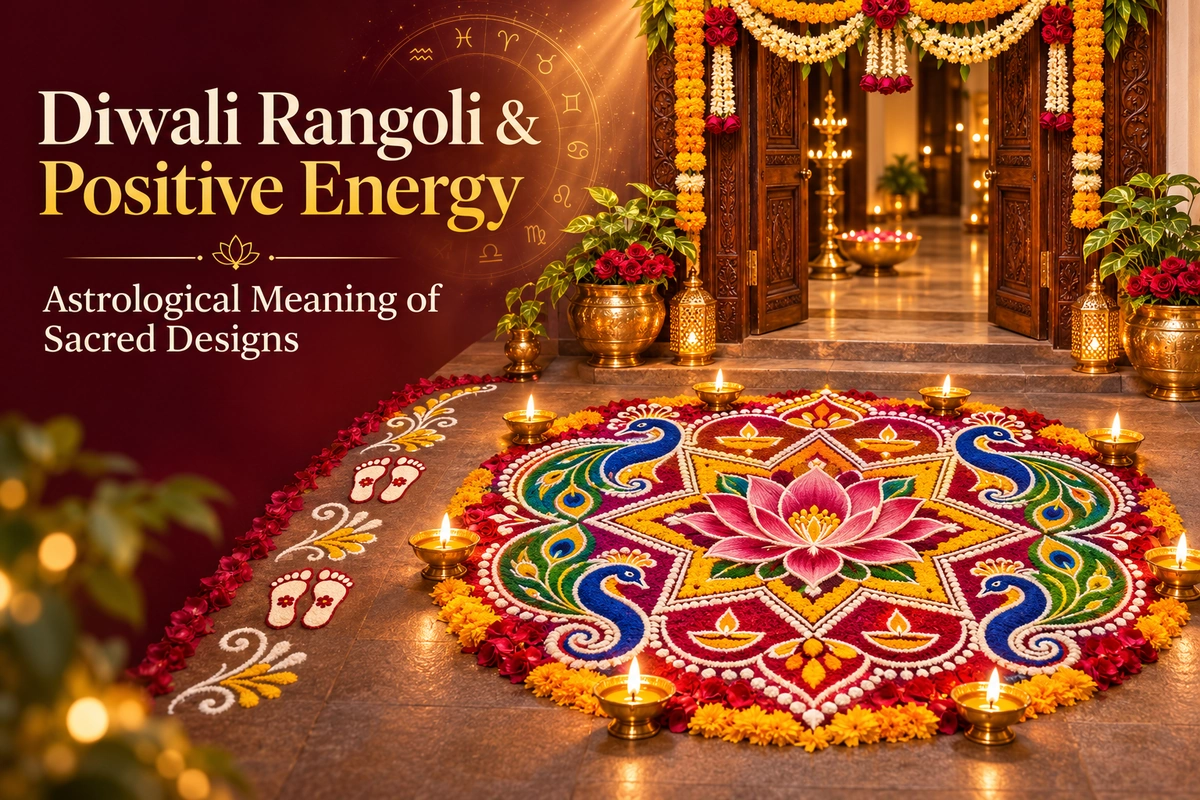
Diwali 2026 falls on Sunday, 8 November, and rangoli at the entrance is traditionally drawn to welcome Goddess Lakshmi and Lord Ganesha. In astrology and Vastu, each motif and colour is linked to a planet: the lotus to Venus and the Moon, the peacock to Mercury, the swastika and diya to the Sun and Mars, and Lakshmi’s footprints, always pointing inward, to the arrival of wealth. Natural colours such as rice flour, turmeric, kumkum and flower petals are preferred, and the main rangoli is ideally made at a north or north-east facing entrance.
Rangoli is so much more than a beautiful festival decoration. As per Vedic & Vastu science, the art of making a Rangoli at the entry of the house on Diwali is a yantra for a psychic landscape that is able to positively influence the vibrations of the atmosphere and ward off Daridrata (bad luck) and attract Goddess Lakshmi & Lord Ganesha. The colors, symmetry & motifs of your rangoli are your home’s yantra to influence the flow of cosmic energy.
Astrological & Vastu Significance of Diwali Rangoli
| Element / Motif | Primary Symbolism | Vastu Direction | Astrological Planetary Benefit |
|---|---|---|---|
| Lotus (Padma) | Purity, Abundance, Goddess Lakshmi | North / East | Strengthens Venus (Shukra) & Moon (Chandra) |
| Peacock (Mayur) | Royalty, Protection, Grace | East / North-East | Enhances Mercury (Budh) & Venus (Shukra) |
| Swastika & Diya | Solar Power, Obstacle Removal | Center / Entrance | Amplifies Sun (Surya) & Mars (Mangal) |
| Geometric Stars (8-Pointed) | Ashta Lakshmi, Balance, Stability | North / North-East | Balances Jupiter (Guru) & Saturn (Shani) |
Sacred Symbols in Rangoli & Their Energy Potential
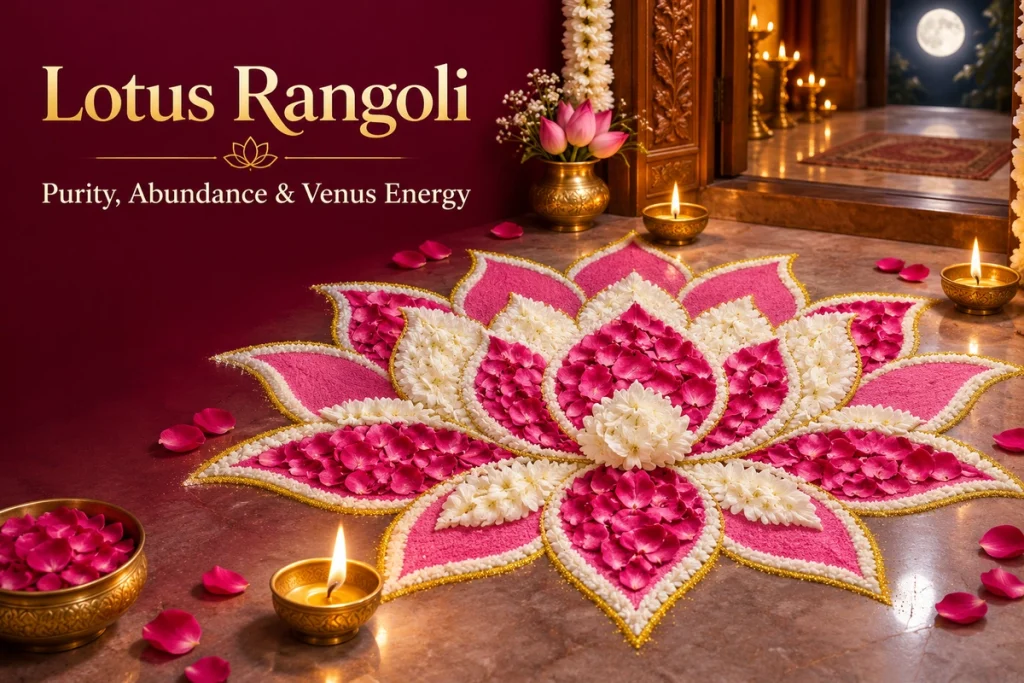
1. The Lotus Flower (Padma Rangoli)
The lotus is the highest symbol of spiritual purity and material wealth, and the Goddess Lakshmi’s Asana. A lotus-shaped design near your home’s entrance or Puja room entrance is the best way to absorb the soft, mystical creative energies of planet Venus (Shukra). This design would create an atmosphere of prosperity, wealth, happiness at home, and an inclination to beautiful things.
Welcoming Goddess Lakshmi this Diwali? Explore Shri Yantra
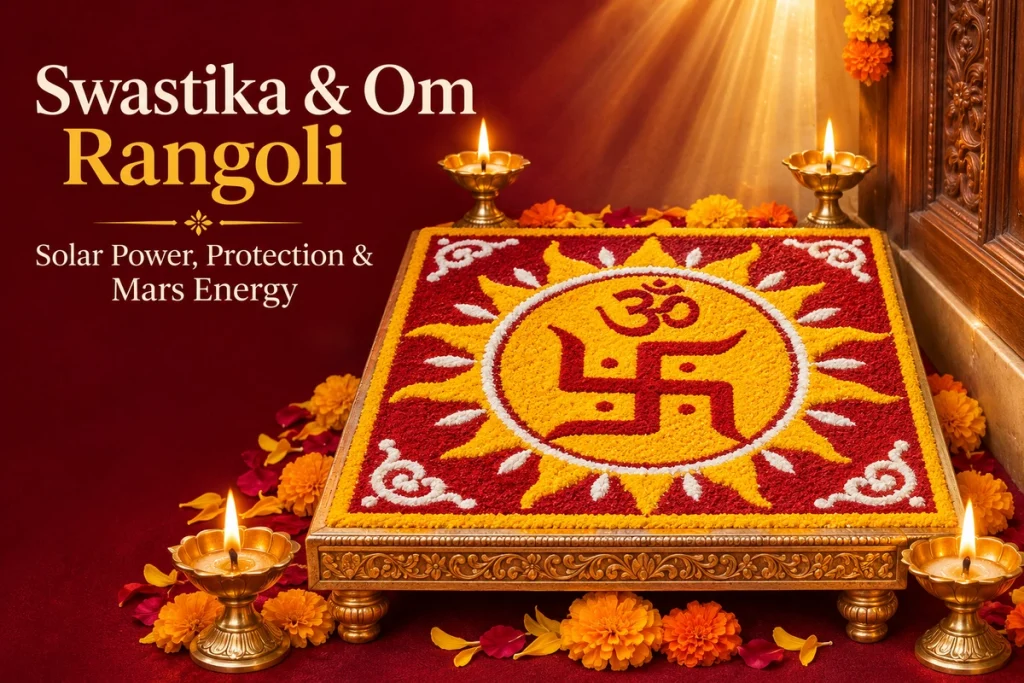
2. The Sacred Swastika & Om Motifs
This Swastika represents the four directions, four Vedas, and the four cycles of creation. With natural Haldi/Kumkum, the Swastika radiates positive vibes, and any bad or evil energies are kept out. Spiritually, this Swastika reduces your fear of something unseen or fear of stagnation in your career and invokes the grace of Lord Ganesha and Surya.
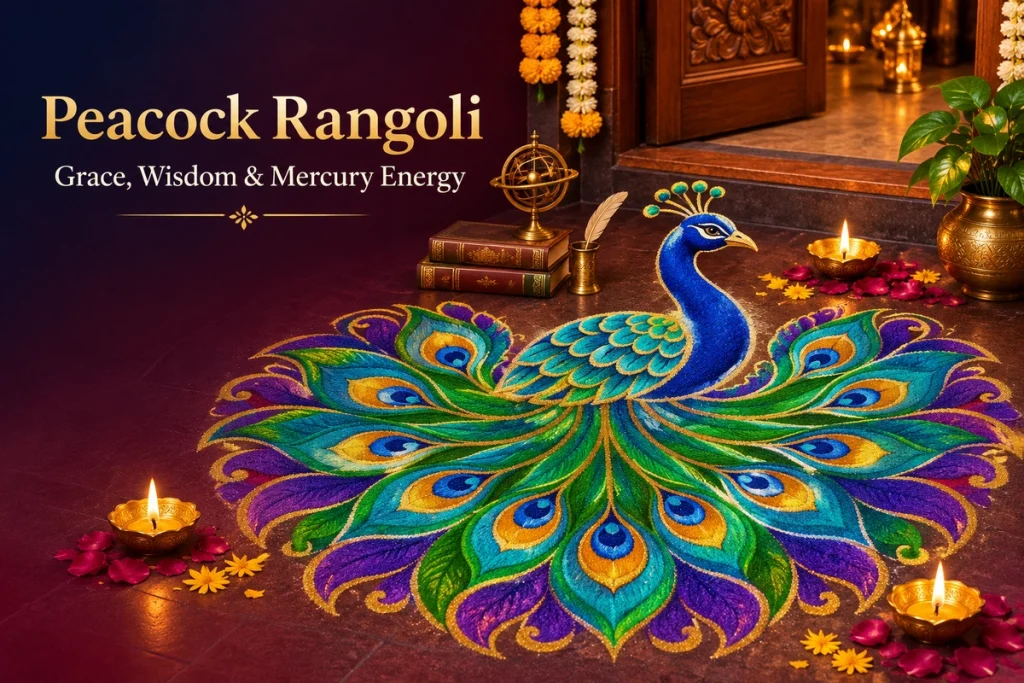
3. The Peacock (Mayur Rangoli)
The peacock is popular for its grace and is linked to Goddess Saraswati and Lord Kartikeya. Rangolis inspired by peacocks with blue, green, and violet tints enhance communication and promote wisdom. This design is dedicated to Mercury (Budh) and is excellent for students, merchants, and professionals.
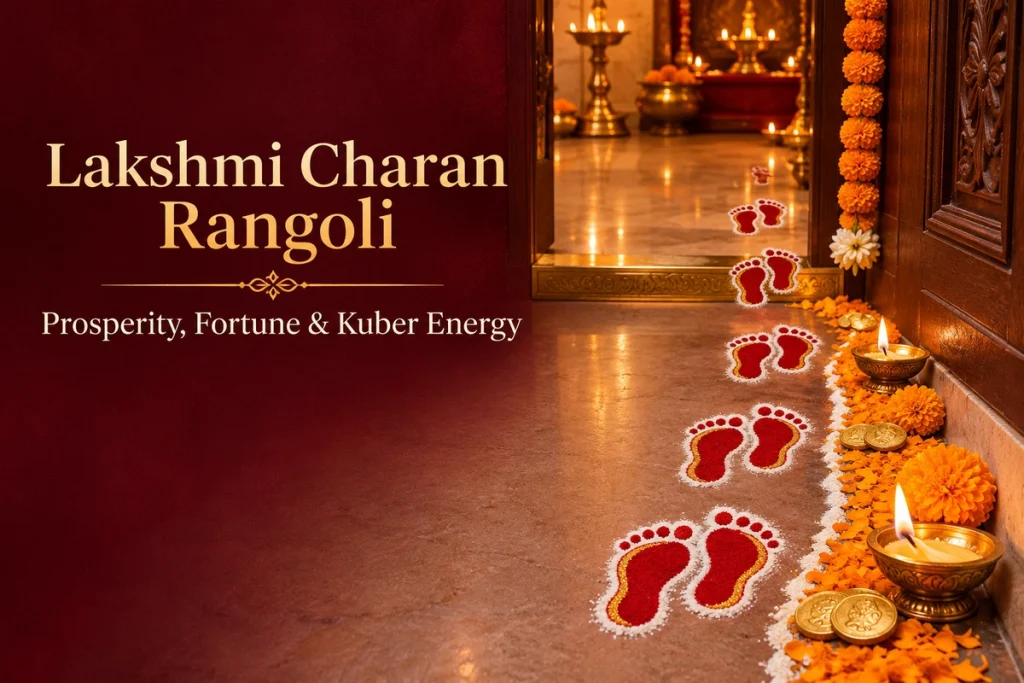
4. Footprints of Goddess Lakshmi (Lakshmi Charan)
One of the most ancient Diwali traditions is to draw tiny footprints toward the house. They are a symbol of the arrival of good fortune and should always point into the home and not out. From an astrological perspective, you are establishing the energy of wealth from Lord Kuber and Goddess Lakshmi within your home.
Rangoli Colors & Planetary Alignment
Bring in natural and colorful Rangoli powders to tune your living space to the positive planetary vibrations:
- Red & Vermilion (Kumkum): Mars (Mangal) is the owner of the colour red in the house. The colour of Mars enhances confidence, energy, and strength.
- Yellow & Turmeric (Haldi): It symbolizes good luck and happiness in marriage. It is ruled by Jupiter (Guru).
- White (Rice Flour / Chalk): White is linked to the Moon, and its energies promote mental and emotional peace and purity.
- Green & Blue: Ruled by Mercury (Budh) and Saturn (Shani), these cool colours support communication, bring healing, and shield against envy.
Vastu Rules for Making Diwali Rangoli
Here are some basic Vastu and astrology principles that should be followed to encourage the flow of positive energy:
- Create the main Rangoli at a Mahadwar (main door) of your house facing North or North-East. It should be in the water/wind area of your house, ruled by Kuber (richness/wealth lord) & Jupiter.
- Whenever possible, try to use natural powders- rice flour, turmeric, dried flower petals- marigold, rose, and other flowers – and herbal colours. Natural powders can conduct a great deal more cosmic energy than chemical-based dyes.
- Do not walk/step on holy symbols like Swastika, Om, or Lakshmi’s feet. When a drawing is to be made at a level on the pathway, it should be drawn aside or on a Chowki.
- Ensure that the threshold is thoroughly washed and sprinkled with Ganga jal before making your design so that all benign energies are absorbed.
Conclusion
A well-designed Diwali Rangoli is a wonderful way to bring art and Vedic science together. Employ regular sacred geometry shapes like lotus, peacocks, and Swastikas and select colors corresponding to the planetary energy to draw in a wave of positive forces into your home, thereby making your Diwali Rangoli a conduit for health, happiness, and prosperity.
Does your main door face a different direction? Get personalised Vastu guidance for your home. Talk to an Astrologer – First Chat Free!
FAQs
What is the significance of the Lotus Rangoli design during Diwali?
The Lotus Rangoli design is a symbol of spiritual purity and material wealth. It is associated with Goddess Lakshmi and is believed to absorb the mystical creative energies of planet Venus, promoting prosperity, wealth, and happiness in the home.
Why is the Swastika motif important in Diwali Rangoli?
The Swastika motif represents the four directions, Vedas, and cycles of creation. It is believed to radiate positive vibes and ward off evil energies, invoking the grace of Lord Ganesha and Surya, and reducing fears of stagnation.
How does the Peacock Rangoli design influence the home environment?
The Peacock Rangoli design, linked to Goddess Saraswati and Lord Kartikeya, enhances communication and promotes wisdom. It is especially beneficial for students and professionals, aligning with the energy of Mercury.
What do the footprints of Goddess Lakshmi symbolize in Rangoli?
The footprints of Goddess Lakshmi in Rangoli symbolize the arrival of good fortune and wealth. They are traditionally drawn pointing into the home to establish the energy of wealth from Lord Kuber and Goddess Lakshmi.
How does Diwali Rangoli combine art and Vedic science?
Diwali Rangoli combines art and Vedic science by using sacred geometry shapes and colors corresponding to planetary energies. This practice is believed to draw positive forces into the home, promoting health, happiness, and prosperity.