



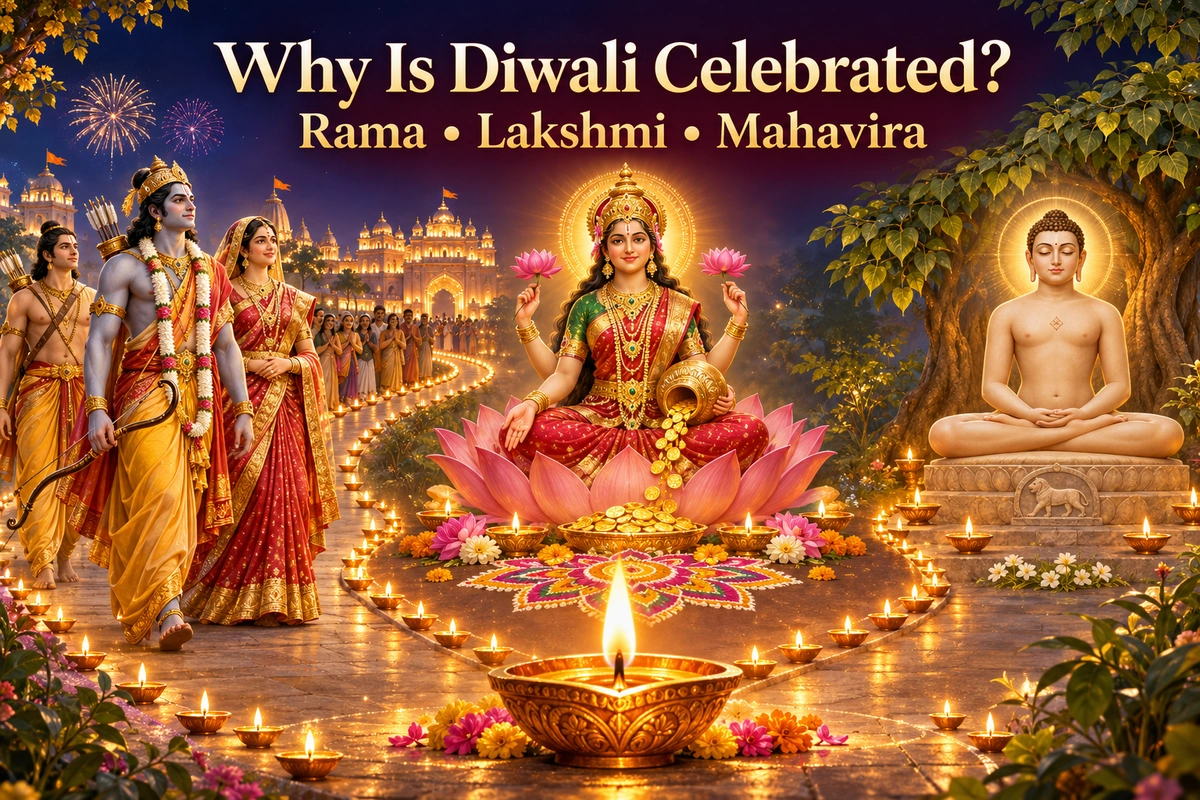
Diwali, or Deepavali (Sanskrit for “a row of lights”), is celebrated for several reasons across traditions. For many Hindus, it marks Lord Rama’s return to Ayodhya with Sita and Lakshmana after 14 years of exile and his victory over Ravana, when the people welcomed them by lighting lamps. It is also associated with Goddess Lakshmi, who emerged from the Samudra Manthan, so families perform Lakshmi Puja and traders worship new account books for prosperity. For Jains, Diwali marks the Nirvana of Lord Mahavira, the 24th Tirthankara, at Pavapuri. All these stories share one message: the victory of light over darkness, knowledge over ignorance and good over evil.
Diwali, also known as Deepavali, is one of India’s most celebrated festivals. Known as the Festival of Lights, it brings families together for prayers, traditional sweets, colourful decorations and the lighting of diyas. But why is Diwali celebrated, and what do the stories of Lord Rama, Goddess Lakshmi and Lord Mahavira have to do with it?
The answer is not limited to one legend. Diwali has different meanings across religious traditions and regions. For many Hindus, it celebrates Lord Rama’s return to Ayodhya. Others associate it with Goddess Lakshmi, the deity of wealth and prosperity. For Jains, Diwali marks the spiritual liberation of Lord Mahavira.
Despite these different stories, the festival shares a powerful message: the triumph of light over darkness, knowledge over ignorance and good over evil.
Why Is Diwali Celebrated? The Meaning Behind the Festival
Diwali is a festival that is celebrated for different reasons, one of which is to express gratitude and invoke prosperity into one’s life.
The origin of the name Deepavali comes from the Sanskrit term meaning a series of lights. The establishment of the practice of lighting diyas is one of the arts associated with the festival of Diwali. This custom represents hope and wisdom and the elimination of darkness in life.
Diwali is an important event not only for Hindus but also for Jains and Sikhs. However, their stories of Diwali are different.
Are You Facing any Problems in Life? So, this is the right time to Connect with our Astrologer on Chat and remove your obstacles. First Chat Free!
To understand why Diwali holds such significance, below are three important stories that shape this festival:
1. Lord Rama’s Return to Ayodhya: The Victory of Good Over Evil
Diwali is popularly associated with the story from the epic Ramayana. In this widely known tale Rama, Sita, and Lakshmana return to Ayodhya after fourteen years of exile. While in exile, Rama defeats Ravana, the ruler of Lanka and rescues Sita. Their return signifies the end of a long period of exile and the re-establishment of dharma. The townsfolk receive them with the lighting of lamps and festivities at their arrival.
What does this story teach us?
The legendary events from the Ramayana associated with Diwali highlight the triumph of virtue over vice and the significance of one’s responsibilities. The lamps symbolize the joy of the people who welcome their rightful king home.
Note: The return of Rama is a widely celebrated Diwali tradition, although the festival has several other regional and religious explanations.
2. Goddess Lakshmi: The Festival of Wealth and Prosperity
Another reason why Diwali is celebrated is due to its association with Goddess Lakshmi, the Hindu goddess of wealth, prosperity and good fortune. According to Hindu mythologies, Lakshmi emerged during Samudra Manthan (churning the ocean). She represents abundance, beauty and good beginnings.
On the day of Diwali, Hindu families perform Lakshmi Puja in order to receive the blessings of the goddess for financial stability and success in life. Homes are cleaned and adorned with flowers, rangoli and diyas in order to make them ready for receiving Goddess Lakshmi.
In several parts of India, businesses also commence their accounts on this day. Traders worship their books of accounts asking for good fortune ahead.
What does Goddess Lakshmi’s connection with Diwali teach us?
Goddess Lakshmi teaches people that they must be prosperous, grateful and responsible in regard to wealth they possess through celebration of this event.
3. Lord Mahavira’s Nirvana: Diwali in Jainism
Diwali has immense importance for the Jain community as well. Jains celebrate this day as the day when Lord Mahavira, the 24th Tirthankara, became liberated at Pavapuri. Liberation is the end of the cycle of life and death and release from karmic bondage.
The Jains believe Mahavira achieved liberation on the night of Diwali. His followers, mourning the passing away of their Guru, lit lamps around.
According to Jain Kalpasutra, lamps were lit as soon as Mahavira achieved Nirvana. This tradition is based on the principle that when the light of a great teacher is no longer physically present with us, one should keep the light shining with lamps.
What does this story teach us?
For Jains, Diwali is a reminder to seek spiritual knowledge, practise self-discipline and work towards liberation.
Rather than focusing only on material prosperity, the celebration encourages people to overcome ignorance, attachment and harmful actions.
What Is the Common Message Behind These Diwali Stories?
Although the stories of Rama, Lakshmi and Mahavira come from different traditions, they share several values.
- Light over darkness: Diyas symbolise hope, wisdom and the removal of ignorance.
- Good over evil: Rama’s return represents the triumph of righteousness.
- Prosperity with gratitude: Lakshmi Puja encourages people to value abundance and responsible living.
- Spiritual growth: Mahavira’s Nirvana reminds devotees that inner peace and liberation are important goals.
Conclusion: Why Do We Celebrate Diwali?
The process of celebrating Diwali varies from culture to culture since different cultures have their own stories behind this holiday. For example, for followers of Hinduism, this festival represents the homecoming of Lord Rama to Ayodhya after the triumph of goodness over evil, while for Jainism, the holiday symbolizes the attainment of Nirvana.
Nonetheless, the bottom line is that although people perform various rites during this day, the underlying idea is similar for all of these traditions.
The core idea of Diwali is to encourage people to accept the ideas of optimism and joyfulness and also give thanks.
In conclusion, Diwali should not be considered just as the day of burning lamps in the houses of all people. Instead, it should mean something deeper.
Know What the Stars Hold for You Upcoming Year. Get Your 2027 Yearly Horoscope Report Now!
FAQs
Why is Diwali celebrated in Hindu tradition?
Diwali is celebrated in Hindu tradition to commemorate Lord Rama’s return to Ayodhya after 14 years of exile and his victory over Ravana. It symbolizes the triumph of virtue over vice and the return of dharma.
What is the significance of Goddess Lakshmi during Diwali?
Goddess Lakshmi, the deity of wealth and prosperity, is worshipped during Diwali. It is believed that she emerged during the Samudra Manthan, and families perform Lakshmi Puja to seek her blessings for financial stability and success.
How do Jains celebrate Diwali?
For Jains, Diwali marks the Nirvana of Lord Mahavira, the 24th Tirthankara, at Pavapuri. It is a time for spiritual reflection and celebration of liberation.
What is the common message shared by the different stories of Diwali?
Despite the different stories, Diwali shares a powerful message of the triumph of light over darkness, knowledge over ignorance, and good over evil.
What are some common practices during Diwali?
Common practices during Diwali include lighting diyas, decorating homes with rangoli and flowers, performing prayers, and enjoying traditional sweets. These activities symbolize hope, wisdom, and the elimination of darkness in life.