


Hora Chart Calculation (D2): Wealth, Financial Stability & Prosperity
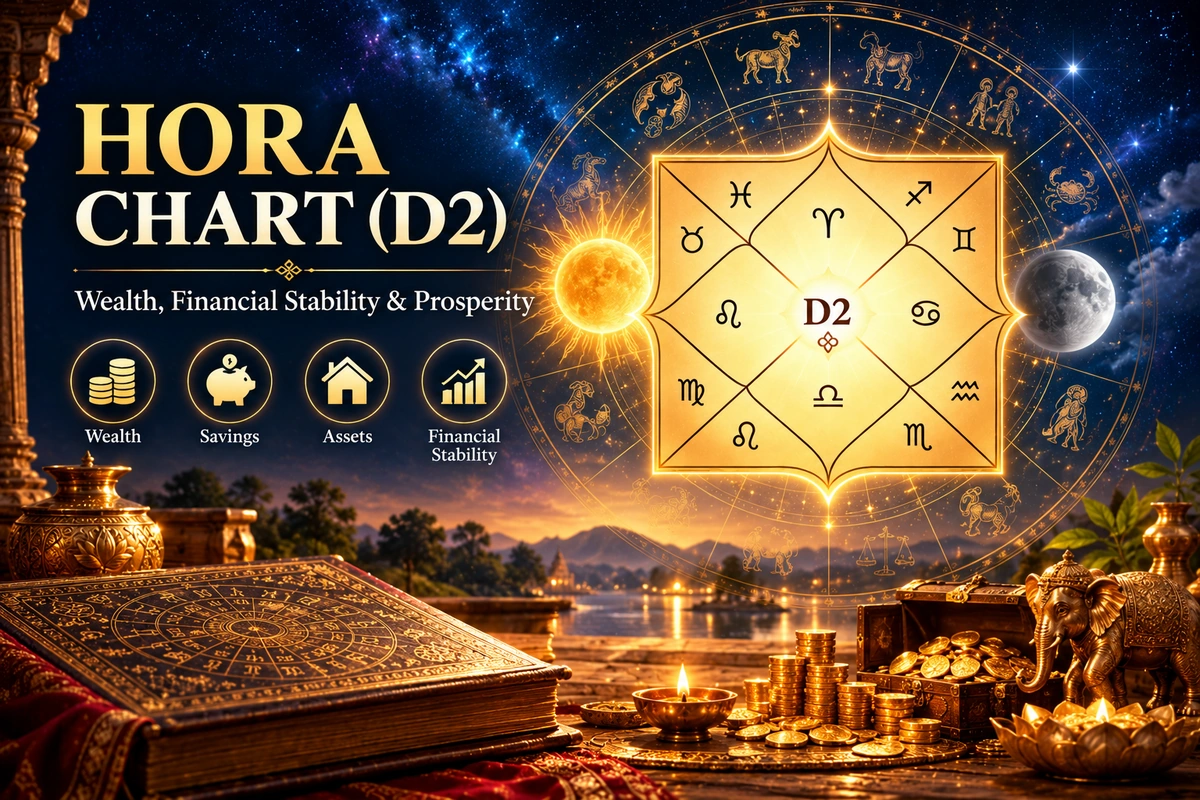
The Hora Chart (D2) is the primary divisional chart used in Vedic astrology to assess a person’s wealth, financial habits, savings, assets, and ability to accumulate resources. While the birth chart (D1) indicates the potential to earn, the D2 chart reveals how effectively an individual manages, preserves, and grows that wealth over time.
Derived from the Sanskrit word Hora, meaning “hour” or “division,” this chart focuses on the financial dimension of life rather than profession or relationships. Classical texts such as Brihat Parashara Hora Shastra assign great importance to the Hora chart when judging prosperity because income alone does not determine financial success. The ability to retain wealth, make sound financial decisions, and build lasting assets is equally significant.
Modern Vedic astrologers study the D2 chart alongside the 2nd house, 11th house, 5th house, 9th house, and 10th house of the birth chart to provide a more complete picture of an individual’s financial journey.
What is the Hora Chart (D2) in Astrology?
The Hora (D2) chart is the second divisional chart (Varga) derived from the birth chart. Its primary purpose is to evaluate financial strength, wealth accumulation, family resources, and material prosperity.
Unlike the D10 chart, which focuses on career, or the D9 chart, which examines marriage and dharma, the Hora chart answers questions such as:
- How strong is the overall wealth potential?
- Are there indications of luxury or financial struggles?
- Does the horoscope support inherited wealth?
- What is the likelihood of financial stability?
- Is the native better at earning or saving?
- Will wealth grow steadily over time?
The D2 chart is particularly useful when analyzing long-term financial patterns rather than temporary gains or losses.
How is the Hora Chart Calculated?
The Hora chart is created by dividing each zodiac sign into two equal parts.
D2 Chart Calculation Method
- Every zodiac sign spans 30 degrees.
- Each sign is divided into 2 Horas.
- Each Hora measures 15 degrees.
Unlike most divisional charts, the Hora follows a unique assignment based on the Sun and the Moon, representing two distinct streams of wealth and sustenance.
Rule of Calculation
For Odd Signs (Aries, Gemini, Leo, Libra, Sagittarius, Aquarius):
- 0°–15° → Sun’s Hora (Leo)
- 15°–30° → Moon’s Hora (Cancer)
For Even Signs (Taurus, Cancer, Virgo, Scorpio, Capricorn, Pisces):
- 0°–15° → Moon’s Hora (Cancer)
- 15°–30° → Sun’s Hora (Leo)
As a result, the D2 chart consists only of Cancer and Leo, symbolizing the Hora of the Moon and the Hora of the Sun respectively.
How to Read & Analyze the Hora Chart
The Hora chart should never be interpreted independently. Astrologers compare it with the birth chart to determine whether financial yogas are likely to produce tangible wealth.
Hora Lagna
The Hora Ascendant indicates a person’s overall financial temperament and approach towards money. A strong Lagna often supports disciplined wealth creation and better financial stability.
The 2nd House
The second house remains one of the most important houses in D2.
It represents:
- Savings
- Family wealth
- Liquid assets
- Speech connected with financial dealings
- Financial security
A strong second house generally supports wealth accumulation over time.
The 11th House
The eleventh house governs:
- Income
- Profits
- Financial gains
- Networks that generate wealth
- Fulfilment of financial ambitions
Benefic influences here often improve earning opportunities and long-term prosperity.
Wealth-Giving Planets
The condition of the natural wealth significators is carefully assessed.
Jupiter
Jupiter signifies abundance, prosperity, ethical wealth, financial wisdom, and expansion.
Venus
Venus indicates luxury, riches, valuable possessions, jewelry, fashion, entertainment, hotels, and all kinds of wealth from creative industries.
Mercury
Mercury represents commerce, trade, accounting, business intelligence, investments, and financial planning.
Moon
The Moon reflects financial stability, cash flow, public support, and emotional spending habits.
Planetary Dignity
Astrologers examine whether planets occupy:
- Enemy signs
- Friendly signs
- Debilitation
- Exaltation
- Own signs
A planet that is strong in both the birth chart and Hora chart generally delivers more stable financial results throughout life.
Dasha and Transit Analysis
Major financial events are judged only after combining:
- Vimshottari Dasha
- Antardasha
- Gochar (planetary transits)
- Birth chart (D1)
- Hora chart (D2)
The D2 chart refines financial predictions but does not independently determine the timing of wealth.
Significance of Houses in the Hora Chart
Although the Hora chart mainly focuses on wealth, each house contributes to financial interpretation.
1st House
Financial mindset, confidence, and ability to manage money.
2nd House
Savings, accumulated wealth, family assets, and financial security.
3rd House
Business initiative, entrepreneurship, marketing, and self-effort.
4th House
Property, real estate, vehicles, and domestic assets.
5th House
Investments, speculation, intelligence, and wealth through creativity.
6th House
Loans, debts, financial disputes, competition, and liabilities.
7th House
Business partnerships, contracts, and wealth through collaborations.
8th House
Inheritance, insurance, taxation, sudden gains or losses, and joint assets.
9th House
Luck, fortune, mentors, and wealth earned through ethics and blessings.
10th House
Professional earnings, reputation, authority, and financial achievements.
11th House
Income, profits, returns on investments, and financial expansion.
12th House
Expenses, charitable giving, foreign expenditures, and financial leakages.
Important Planets in the Hora Chart
Sun in D2
The Sun supports wealth through leadership, administration, government positions, authority, and recognition. A strong Sun often indicates financial independence and confidence.
Moon in D2
The Moon governs liquidity, cash flow, family wealth, public support, and financial adaptability. It also reflects spending habits and emotional decisions involving money.
Mars in D2
Mars indicates wealth earned through engineering, technical professions, real estate, construction, defence, or entrepreneurship. Poorly placed Mars may increase impulsive financial decisions.
Mercury in D2
Mercury strengthens business skills, commerce, investments, trading, communication, and analytical financial planning.
Jupiter in D2
Jupiter is one of the strongest wealth indicators, supporting prosperity, ethical earnings, long-term investments, education, consulting, and financial expansion.
Venus in D2
Venus represents luxury, valuable assets, jewellery, fashion, entertainment, hospitality, and wealth derived from creative industries.
Saturn in D2
Saturn delights in wealth which comes from discipline, patience, investment, and continual hard work. It may take a long time to make money, but the process is a permanent one.
Rahu and Ketu in D2
Rahu may make one rich overnight, thanks to foreign earnings, odd investments, and speculation, but also increase risks at the same time. Ketu gives support for detachment from financial processes, making money based on research, and making money in ways that are unusual.
How the Hora Chart Helps in Financial Prediction
The Hora chart refines financial analysis by revealing the quality of wealth rather than simply the ability to earn. It helps astrologers understand:
- Capacity to accumulate savings
- Long-term financial stability
- Investment potential
- Family wealth and inheritance
- Business versus salaried income
- Luxury and lifestyle
- Spending patterns
- Financial risks and setbacks
A favourable Hora chart combined with strong wealth yogas in the birth chart generally indicates lasting financial security rather than temporary prosperity.
Conclusion
The Hora Chart (D2) is a tool used for financial analysis in Vedic astrology. It shares insight into issues such as the creation of wealth, savings, investments, assets, and overall financial security. However, it is essential to analyze the D2 chart along with the natal horoscope, planetary dashas (Vedic time periods), and transits of planets to provide accurate predictions.
The Hora chart tells us not only about the ability to earn, but it also explains how wealth has been built, protected, and maintained throughout life.
Get Your Personalized Hora (D2) Chart Analysis
If you are interested in knowing your wealth status or your prospects, and investing opportunities, consult with professionals specializing in Vedic astrology for a proper Hora (D2) chart analysis from the chart of your birth time, dashas, and transits.
FAQs
What is the Hora Chart (D2) in Astrology?
The Hora Chart (D2) is a divisional chart in Vedic astrology used to assess a person’s wealth, financial habits, savings, and ability to accumulate resources. It focuses on the financial dimension of life, unlike the birth chart (D1) which indicates earning potential.
How is the Hora Chart (D2) calculated?
The Hora Chart is created by dividing each zodiac sign into two equal parts, associated with the Sun and the Moon. Odd signs are divided into Leo and Cancer, while even signs are divided into Cancer and Leo.
What is the significance of the 2nd house in the Hora Chart?
In the Hora Chart, the 2nd house is crucial as it represents financial strength, wealth accumulation, family resources, and material prosperity. It plays a significant role in analyzing an individual’s financial stability.
Why is the Hora Chart important in Vedic astrology?
The Hora Chart is important because it provides insights into how effectively an individual manages, preserves, and grows wealth over time, which is crucial for assessing long-term financial success beyond mere income.
How does the Hora Chart differ from other divisional charts?
Unlike other divisional charts like the D10 (career) or D9 (marriage), the Hora Chart focuses specifically on financial aspects, using a unique method based on the Sun and Moon to analyze wealth and sustenance.