


Navamsa Chart Calculation: D9 Chart Analysis for Marriage, Dharma & Destiny
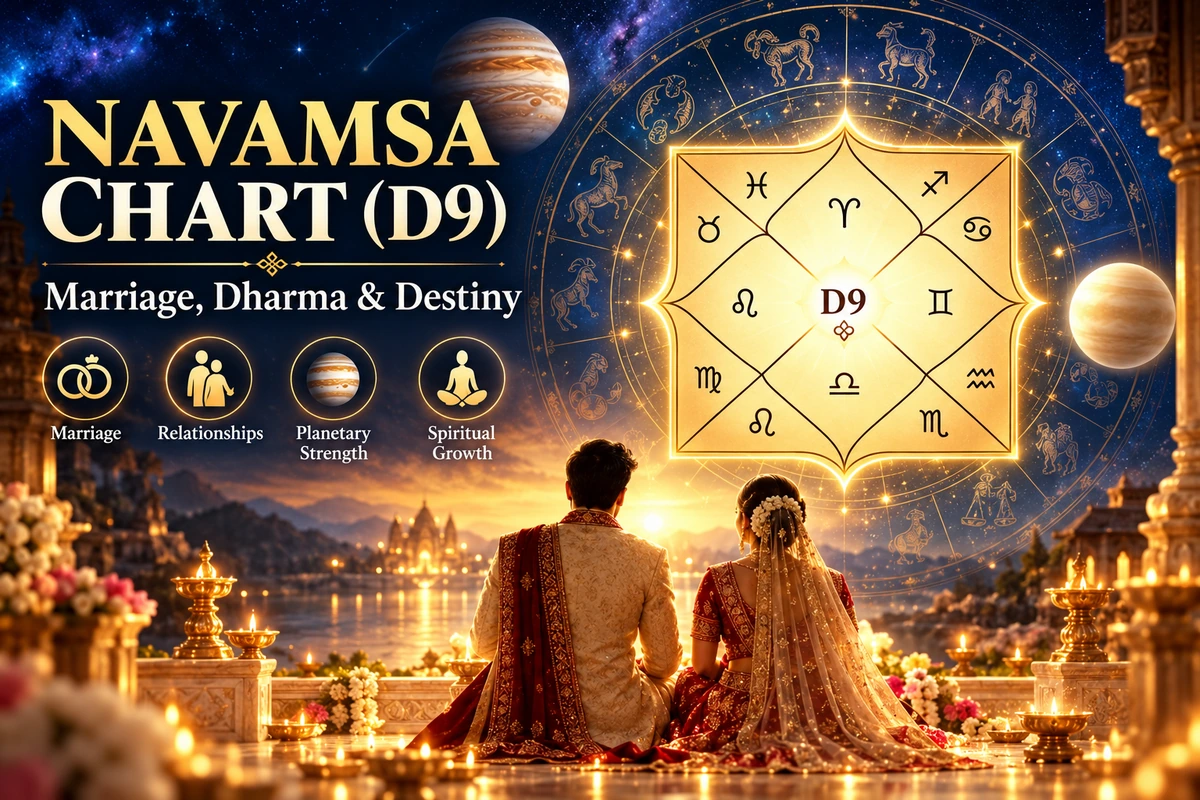
The Navamsa Chart (D9) is one of the most important divisional charts in Vedic astrology. While the birth chart (D1) shows the overall promise of life, the D9 chart reveals how those promises mature over time. It is primarily used to analyze marriage, spouse, relationships, dharma (life purpose), spiritual growth, and the true strength of planets.
Classical texts such as Brihat Parashara Hora Shastra regard the Navamsa as essential for accurate horoscope analysis. Many astrologers believe that no prediction about marriage or long-term success should be made without studying both the birth chart and the D9 chart together. A planet that appears strong in the birth chart but weak in the Navamsa may not deliver its full potential, while a strong D9 placement can enhance planetary results throughout life.
What is the Navamsa Chart (D9) in Astrology?
The term Navamsa is derived from the Sanskrit words Nava meaning ‘nine’ and Amsa meaning ‘division’. The D9 chart is made by splitting every sign of the zodiac into nine equal sections, thereby creating a new chart that indicates the depth of the strength of the horoscope.
The Navamsa chart helps astrologers understand:
- Long-term success of yogas
- Fortune after marriage
- Spiritual growth
- Dharma and life purpose
- Planetary strength
- Relationship compatibility
- Nature of the spouse
- Marriage and married life
How is the D9 Chart Calculated?
Each sign of the zodiac makes up 30 degrees and can be further split into nine parts, where every single Navamsa is equal to 3°20′.
Example
- 0°00’–3°20′ = First Navamsa
- 3°20’–6°40′ = Second Navamsa
- 6°40’–10°00′ = Third Navamsa
Factors such as the birth sign’s being movable, immovable, or dual play a role in the assignment of the Navamsa sign, hence making the process more complicated than just dividing it by 9. Most astrologers prefer using astrology software or online calculators for preparing the D9 chart.
How to Read & Analyze the Navamsa Chart
The Navamsa chart should always be studied alongside the birth chart for meaningful predictions.
D9 Ascendant (Navamsa Lagna)
The Navamsa Lagna is a measure of a person’s true self, principles and the progress of life after reaching maturity. However, if the Lagna and Lagna Lord are powerful, then we can expect emotional steadiness, the ability to weather adversities, and have a smooth journey in married life.
7th House and 7th Lord
The seventh house plays a crucial part in marriage interpretation. The traits of one’s partner, marital bonds, fidelity, and duration of partnership can be understood from here. The placement of the ruler of the seventh and its dignity will help determine the quality of married life.
Venus and Jupiter
Venus symbolizes love and attraction, and Jupiter denotes wisdom and values of family. Both these planets should be examined in order to determine how relationships function.
Planetary Strength
The major purpose served by using the D9 chart is that it makes it possible to see if a certain planet is really strong or not. A planet that looks strong in the D1 chart delivers its full results only if it is also well placed in the Navamsa.
Dasha and Transit
Marriage timing and major relationship events are judged by combining the Navamsa with Vimshottari Dasha, Antardasha, planetary transits (Gochar), and the birth chart. The D9 chart alone is not used for event prediction.
Significance of Houses in the D9 Chart
1st House: Personality, self-development, and overall married life.
2nd House: Family, wealth, speech, and values after marriage.
3rd House: Communication, effort, courage, and mutual understanding.
4th House: Domestic happiness, emotional comfort, and home life.
5th House: Love, romance, children, creativity, and emotional bonding.
6th House: Conflicts, competition, health, and adjustments in marriage.
7th House: Marriage, spouse, partnerships, and relationship quality.
8th House: Transformation, intimacy, longevity of marriage, and unexpected events.
9th House: Fortune, blessings, spirituality, mentors, and dharma.
10th House: Responsibilities, public image, and karma after marriage.
11th House: Professional and personal gains, fulfilment of desires, and social support.
12th House: Expenses, foreign residence, privacy, spiritual growth, and bed pleasures.
Important Planets in the D9 Chart
Sun in D9
Represents confidence, authority, self-respect, and leadership within relationships.
Moon in D9
Shows emotional compatibility, sensitivity, nurturing qualities, and mental peace.
Mars in D9
Denotes passion, bravery, assertiveness, and physical energy. Depending on its position, it may also bring about impatience or conflicts.
Mercury in D9
Influences communication, adaptability, learning, and intellectual compatibility between partners.
Jupiter in D9
Represents wisdom, prosperity, family values, guidance, and spiritual growth.
Venus in D9
The primary significator of marriage, romance, affection, harmony, beauty, and marital happiness.
Saturn in D9
Represents commitment, discipline, patience, responsibility, and long-term stability. It may delay marriage but often supports lasting relationships.
Rahu and Ketu in D9
Rahu is connected to unusual relationships, people from overseas, and surprising events, while Ketu symbolizes detachment, lessons, and spiritual progress.
How the Navamsa Chart Helps in Marriage Prediction
The Navamsa chart is one of the most reliable techniques to know about the quality of marriage. This chart does not just predict the likelihood of marriage but also provides the relationship dynamics.
A D9 analysis helps assess:
- Marriage prospects
- Nature of the spouse
- Emotional compatibility
- Marital harmony
- Delays or obstacles in marriage
- Prosperity after marriage
- Spiritual connection between partners
Astrologers compare the D9 chart with the birth chart to confirm whether marriage-related yogas are likely to produce favourable results.
Other Important Factors in the D9 Chart
A complete Navamsa analysis includes several additional factors beyond the seventh house.
These include:
- Navamsa Lagna and Lagna lord
- Venus and Jupiter
- Vargottama planets
- Darakaraka
- Upapada Lagna
- Karakamsha (Atmakaraka in Navamsa)
- Benefic and malefic aspects
- Planetary dignity
- Dasha and transit support
Studying the D1 and D9 charts together gives the utmost insight into the concept of marriage, destiny, and spirituality.
Conclusion
In Vedic astrology, the Navamsa chart (D9) is highly significant. It gives greater insight into marriage, spouse, dharma, the strength of the planets, and destiny. This chart shows not only the compatibility factor, but also personal spiritual development.
Thus, for efficient predictions, the Navamsa chart has to be used together with the birth chart, planetary dashas, and ongoing planetary transits.
Get Your Personalized Navamsa (D9) Chart Analysis
Do you want to know the prospects of your marriage, your compatibility in relationships, or the full strength of your horoscope? Then you should talk to a professional Vedic astrologer to receive a thorough analysis of your Navamsa (D9) chart based on your birth chart and dashas.
FAQs
What is the Navamsa Chart (D9) in Astrology?
The Navamsa Chart (D9) is a crucial divisional chart in Vedic astrology used to analyze marriage, relationships, spiritual growth, and the true strength of planets. It complements the birth chart by showing how the promises of life mature over time.
How is the Navamsa Chart (D9) calculated?
The Navamsa Chart is calculated by dividing each zodiac sign into nine equal parts, with each part representing 3°20′. The process considers the nature of the birth sign and often requires astrology software for accuracy.
Why is the Navamsa Chart important for marriage predictions?
The Navamsa Chart is vital for marriage predictions because it reveals the maturity of planetary promises related to marriage, the qualities of the spouse, and the overall quality of married life when analyzed with the birth chart.
What role does the 7th House play in the Navamsa Chart?
The 7th House in the Navamsa Chart is crucial for understanding marriage. It indicates the traits of one’s partner, marital bonds, fidelity, and the duration of the partnership, with the ruler’s placement determining the quality of married life.
How do Venus and Jupiter influence relationships in the Navamsa Chart?
In the Navamsa Chart, Venus symbolizes love and attraction, while Jupiter represents wisdom and family values. Their placements are analyzed to determine the functioning and harmony of relationships.