



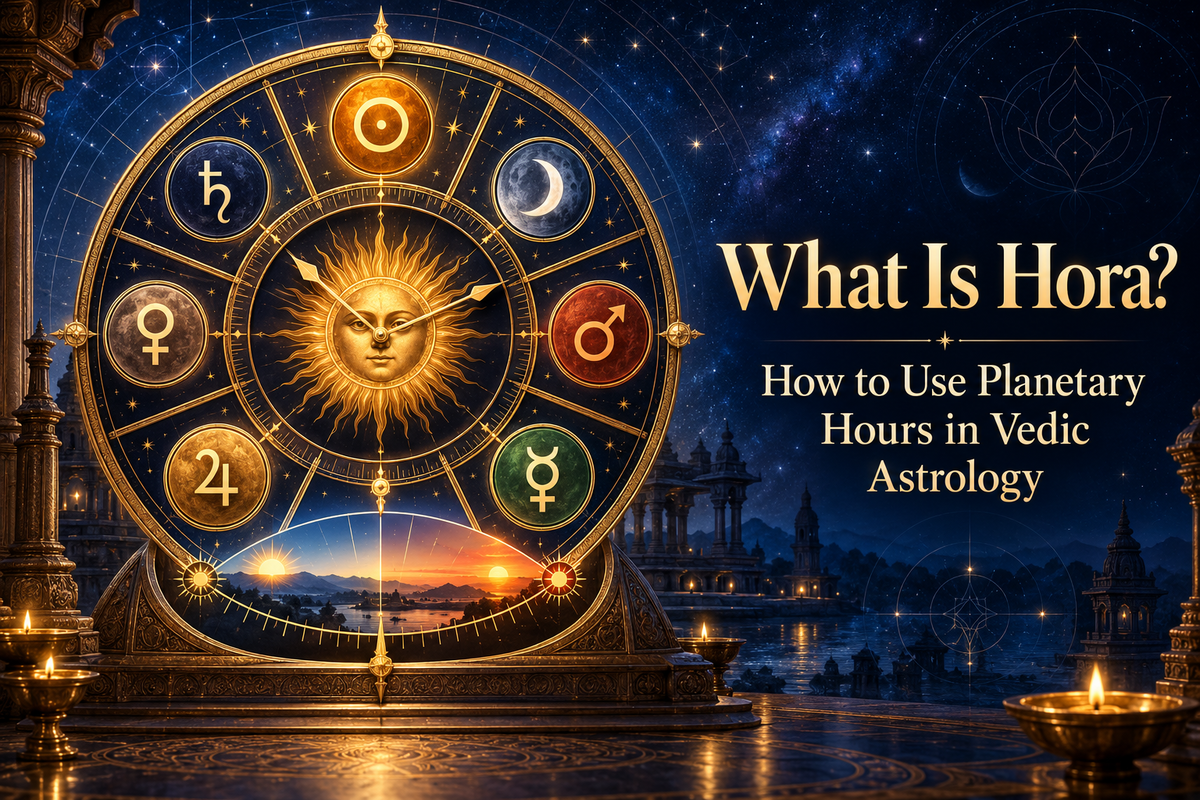
Hora, or planetary hours, divides the day (sunrise to sunset) and the night (sunset to sunrise) into 12 horas each, every one ruled by one of the seven classical planets. The first hora of each day is ruled by the day’s lord, such as Sun Hora at sunrise on Sunday. Astrologers match the hora to the task: Mercury Hora for business and communication, Jupiter Hora for learning, Venus Hora for relationships and art, and Saturn Hora for disciplined, routine work.
Have you ever wondered why certain times are considered suitable for starting a business, having an important conversation, or beginning a new project in astrology? One traditional method used to select a time is Hora, or planetary hours.
In Vedic astrology, planetary Hora divides the day and night into periods ruled by seven classical planets. Each planet is associated with particular activities, so astrologers use these periods to identify a time that symbolically matches the task at hand.
For example, Mercury Hora is traditionally associated with communication and trade, while Jupiter Hora is linked with learning, guidance, and auspicious beginnings. Understanding these associations can help you explore how planetary hours are used in traditional astrological timing.
What Is Hora in Astrology?
Hora is a timekeeping service based on planets. The daytime, which is the time from sunrise to sunset is split into 12 horas, and the night, from sunset to sunrise, is split into another 12. Each hora is associated with one of the seven classical planets: sun, moon, mars, mercury, jupiter, venus, or saturn.
Do not confuse this term with Hora Chart (D2). While both terms use the word ‘Hora’, the two concepts are entirely different.
Planetary hours are used mainly for timing any activity. The idea behind it is to select a period ruled by a planet having a traditional relationship with the activity which needs to be performed.
How Are Planetary Hours Calculated?
Planetary hours do not always last exactly 60 minutes. Their duration depends on the length of daylight and nighttime on a particular date and at a particular location.
The calculation follows three basic steps:
- Find the local sunrise and sunset times.
- Divide the daylight period by 12 to calculate the 12 daytime horas.
- Divide the period from sunset to the next sunrise by 12 to calculate the 12 nighttime horas.
Which Planet Rules Each Day?
| Day | Ruling planet | First Hora |
|---|---|---|
| Sunday | Sun | Sun Hora |
| Monday | Moon | Moon Hora |
| Tuesday | Mars | Mars Hora |
| Wednesday | Mercury | Mercury Hora |
| Thursday | Jupiter | Jupiter Hora |
| Friday | Venus | Venus Hora |
| Saturday | Saturn | Saturn Hora |
Compare Planets: Which Activities Suit Each Hora?
In traditional astrology, each planet represents particular qualities and areas of life. The following matrix summarises common associations used when choosing planetary hours. These are traditional interpretations, not guarantees of success.
| Planetary Hora | Activities Traditionally Favoured | Practical Examples |
|---|---|---|
| Sun Hora | Leadership, authority, recognition, government-related work | Presenting a proposal, meeting a senior official, taking a leadership role |
| Moon Hora | Travel, family matters, care, public interaction | Planning a trip, discussing family matters, handling customer concerns |
| Mars Hora | Courage, competition, physical effort, decisive action | Exercise, sports, tackling a demanding task, taking action on a delayed project |
| Mercury Hora | Communication, trade, learning, calculation | Writing, studying, negotiating, reviewing accounts, discussing business |
| Jupiter Hora | Education, wisdom, guidance, growth, religious activities | Consulting a mentor, teaching, charitable work, studying, planning long-term goals |
| Venus Hora | Love, relationships, art, beauty, comfort | Spending time with a partner, creative work, social events, beauty-related activities |
| Saturn Hora | Discipline, patience, labour, organisation, long-term responsibilities | Clearing pending work, organising records, maintenance, completing repetitive tasks |
Traditionally, a gemstone is also first worn during the Hora of its ruling planet, such as Ruby in Sun Hora, Emerald in Mercury Hora or Yellow Sapphire in Jupiter Hora. Gemstones should be chosen on the basis of your birth chart.
Looking for a gemstone suited to your chart? Explore Gemstones
How to Choose a Hora for Your Activity
For businesses and communication: Mercury Hora is generally known to be related to commerce, negotiations, writing, and analytical thinking. It can be chosen for a project proposal, document inspection, or some sort of business meeting.
For studies and education: Jupiter Hora is often widely linked with knowledge, education, wisdom, and expansion. It can find use in student education, or people looking for some guidance in achieving long term objectives.
For creativity and relations: Venus Hora is said to be influential in matters of love, harmony, aestheticism, and art. This Hora can be used for important discussions with your partner, creative activities, or notable public performances.
For authority and power: Sun Hora is connected with power, reputation, and self-assurance, and it is often used for giving talks and projects.
For hard work: Mars Hora means activity, courage, and initiative and Saturn Hora symbolizes constant effort and routine work.
Check your local Hora timings. Use GaneshaSpeaks’ Hora timings for your city, or a reliable Panchang, for the exact times on your date.
How to Use Planetary Hours in Everyday Life
You can explore Hora without making your schedule unnecessarily complicated.
- Identify your goal. Decide whether you want to study, communicate, complete routine work, or focus on relationships.
- Check your local Hora timings. Use a planetary-hour calculator or a reliable Panchang that provides the timings for your city and date.
- Match the planet to the task. Refer to the activity matrix above to identify the traditional planetary association.
- Keep practical factors in mind. Deadlines, accessibility, readiness, and a piece of professional advice should thus be more important than timing according to astrological considerations.
For example, a person who wants to hold a business meeting might be interested in timing according to Mercury Hora while one who is going to have a group learning session might look at Jupiter Hora. However, these may simply be traditional preference rather than evidence that certain time will be more productive.
Is Hora Enough to Find an Auspicious Time?
This is not necessarily the case. Planetary Hora is just one of the traditional methods for determining auspicious timing. Other factors might be taken into account when deciding on Muhurat, including the Panchang, Tithi, day of the week, Nakshatra, position of the planets, and the purpose of the event.
Factors to consider might differ depending on the particular astrology tradition. Therefore, a favourable planetary interval cannot be seen as an indicator that the chosen time is good for any important action.
It should also be treated as important that despite the fact that Hora calculations are based on scientific data like sunset and sunrise time, interpretation of planet impacts is an element of traditional astrology rather than scientific way of forecasting future events.
Conclusion
Hora is a conventional method of combining daily tasks with the symbolism of planets. Sun Hora applies to power and authority, Mercury Hora to networking, Jupiter Hora to education, Venus Hora – to interpersonal relationships, and Saturn Hora to discipline and hard work.
Having knowledge of the planetary sequence and the locally calculated time, one is able to see what Hora means in the Vedic astrological culture. Still, when making important choices, it is better to treat Hora as a cultural approach, rather than the means of making decisions.
Explore Personalised Astrological Guidance
Would you like to know how everything connects: planetary hours, the natal chart, and the Muhurat used? Don’t hesitate to turn to the professional Vedic astrologer of GaneshaSpeaks, who will be able to offer the necessary assistance.
Want to know how planetary hours, your birth chart and Muhurat fit together for an important decision? Talk to an Astrologer!
FAQs
What is Hora in Astrology?
Hora, or planetary hours, in astrology divides the day and night into 12 periods each, ruled by one of the seven classical planets. These horas are used to find auspicious times for various activities.
How is Hora calculated in Vedic Astrology?
In Vedic Astrology, Hora is calculated by dividing the time from sunrise to sunset into 12 equal parts, and similarly from sunset to sunrise. Each segment is ruled by a planet, with the first Hora of the day ruled by the day’s planetary lord.
Which activities are best suited for Mercury Hora?
Mercury Hora is ideal for activities related to communication, business, negotiations, writing, and analytical tasks. It is suitable for project proposals, document reviews, and business meetings.
What activities are associated with Jupiter Hora?
Jupiter Hora is linked with knowledge, education, wisdom, and expansion. It is beneficial for student education and for those seeking guidance in achieving long-term objectives.
How do planetary hours differ from standard hours?
Planetary hours do not always last exactly 60 minutes. Their duration varies based on the length of daylight and nighttime on a specific date and location, unlike standard hours which are fixed.