


Vimshamsa Chart Calculation: D20 Chart Analysis for Spirituality
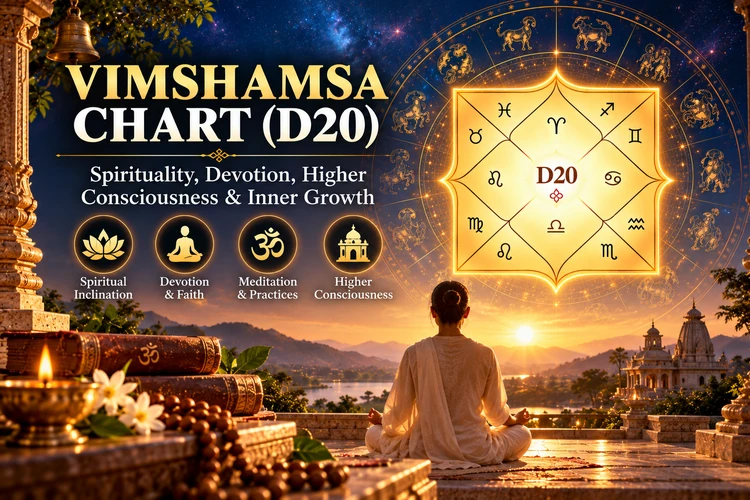
The Vimshamsa Chart (D20) is an important divisional chart in Vedic astrology used to analyse spirituality, devotion, religious practices, meditation and inner growth. While the birth chart (D1) provides the overall picture of life, the D20 chart offers deeper insight into a person’s spiritual inclination and relationship with faith and higher consciousness.
The Vimshamsa chart is particularly useful for understanding one’s interest in spiritual practices, religious traditions, worship, meditation and the search for deeper meaning. Astrologers generally study it alongside the D1 chart, especially the 5th, 9th and 12th houses, their lords and relevant planetary dashas.
What is the Vimshamsa Chart (D20) in Astrology?
The word Vimshamsa comes from the Sanskrit terms Vimshati, meaning ‘twenty’, and Amsa, meaning ‘division’. The D20 is the twentieth divisional chart in Vedic astrology and is mainly associated with spirituality, devotion, religious practices and inner development.
The Vimshamsa chart helps astrologers understand:
- Spiritual inclination
- Devotion and faith
- Meditation and religious practices
- Interest in occult and spiritual subjects
- Connection with teachers and gurus
- Inner transformation
- Religious discipline
- Search for higher knowledge
How is the Vimshamsa Chart Calculated?
Each zodiac sign consists of 30 degrees and is divided into twenty equal parts to create the Vimshamsa chart.
Calculation Method
- Every zodiac sign spans 30 degrees.
- Each sign is divided into 20 equal parts.
- Each Vimshamsa measures 1°30′.
Example
- 0°00’–1°30′ = First Vimshamsa
- 1°30’–3°00′ = Second Vimshamsa
- 3°00’–4°30′ = Third Vimshamsa
- 4°30’–6°00′ = Fourth Vimshamsa
The complete sequence continues through the 30-degree span of each zodiac sign. The assignment of signs in the D20 follows specific divisional rules based on the nature of the sign. Since the calculation is more complex than simply dividing a sign into twenty parts, astrologers generally use astrology software to prepare the chart accurately.
How to Read & Analyze the Vimshamsa Chart
The D20 chart should be interpreted alongside the birth chart rather than independently. The 5th, 9th and 12th houses, their lords and relevant planets in the D1 chart remain important when analysing spirituality and religious inclination.
D20 Ascendant (Vimshamsa Lagna)
The D20 Lagna provides insight into a person’s spiritual temperament, devotion and approach towards inner development. Its strength and the condition of the D20 Lagna lord can indicate how naturally a person is drawn towards spiritual practices.
5th House and 5th Lord
The fifth house represents mantra, devotion, spiritual intelligence, learning and past-life impressions. Its condition can provide insight into one’s ability to develop concentration and engage in spiritual or devotional practices.
9th House and 9th Lord
The ninth house is associated with dharma, faith, teachers, gurus, religious traditions and higher knowledge. A strong ninth house can support a sincere interest in spiritual learning and guidance.
12th House and 12th Lord
The twelfth house represents meditation, retreat, detachment, liberation and experiences beyond material concerns. Its condition is therefore important when assessing deeper spiritual practices.
Jupiter and Ketu
Jupiter is associated with wisdom, teachers, philosophy and higher knowledge, while Ketu represents detachment, intuition and spiritual seeking. Their strength and influence are important factors in D20 analysis.
Planetary Strength
Astrologers can utilize the D20 chart to determine the degree to which spiritual and devotional symbols within the natal chart are present. Strong influences may help enhance spiritual discipline and understanding, while adverse indications may suggest possible interruptions in the practice.
Dasha and Transit
Major spiritual developments are generally judged by combining the D20 chart with Vimshottari Dasha, Antardasha, planetary transits (Gochar), the relevant houses and the birth chart. The D20 chart alone is not used to determine the timing of specific spiritual events.
Significance of Houses in the D20 Chart
1st House
Spiritual personality, faith, inner orientation and personal approach to spiritual growth.
2nd House
Speech, mantras, family traditions, values and knowledge expressed through words.
3rd House
Personal effort, discipline, spiritual practices, communication and determination.
4th House
Inner peace, emotional faith, devotion and the sense of spiritual comfort.
5th House
Mantra, devotion, meditation, spiritual intelligence and past-life impressions.
6th House
Spiritual discipline, service, obstacles and the ability to overcome distractions.
7th House
Spiritual relationships, teachers, partnerships and guidance received through others.
8th House
Transformation, occult subjects, hidden knowledge and deeper spiritual experiences.
9th House
Dharma, faith, gurus, religious traditions, higher learning and spiritual guidance.
10th House
Spiritual duties, religious service, discipline and actions connected with one’s beliefs.
11th House
Spiritual gains, fulfilment, support from spiritual communities and progress through practice.
12th House
Meditation, solitude, detachment, spiritual retreats, liberation and withdrawal from material concerns.
Important Planets in the Vimshamsa Chart
Sun in D20
The Sun represents self-awareness, discipline, authority and spiritual confidence. Its influence can support a strong sense of purpose and dedication to one’s spiritual path.
Moon in D20
The Moon represents faith, devotion, emotional sensitivity and the inner mind. Its condition can influence one’s emotional connection with prayer, meditation and spiritual practices.
Mars in D20
Mars represents discipline, courage, energy and determination. A strong Mars may support rigorous spiritual practice and the willingness to overcome obstacles.
Mercury in D20
Mercury influences learning, reasoning, study and communication. Its placement can support interest in spiritual texts, philosophy, astrology and the analytical study of religious subjects.
Jupiter in D20
Jupiter is one of the most important planets for spirituality. It represents wisdom, dharma, teachers, philosophy and higher knowledge. A strong Jupiter may support guidance from gurus and a sincere interest in spiritual learning.
Venus in D20
Venus represents devotion, beauty, compassion, harmony and the emotional enjoyment of religious or spiritual practices. Its influence can support devotional traditions and artistic forms of worship.
Saturn in D20
Saturn represents discipline, patience, austerity and long-term commitment. Its influence may encourage a serious and structured approach to spiritual practice, particularly through sustained effort.
Rahu and Ketu in D20
According to Rahu, unusual spiritual interests and teachers or a quest for different traditions may occur. Conversely, Ketu is related to detachment from worldly matters, intuition, mysteries, and freedom through spirituality.
How the Vimshamsa Chart Helps in Spiritual Prediction
The D20 chart provides additional insight into spirituality and religious inclination beyond what is visible from the birth chart. It can help astrologers examine:
- Spiritual inclination and faith
- Devotion and religious practices
- Meditation and mantra practices
- Interest in occult and mystical subjects
- Relationship with gurus and teachers
- Spiritual discipline
- Inner transformation
- Detachment and search for higher knowledge
A favourable D20 chart, supported by strong indications in the D1 chart and suitable planetary dashas and transits, may strengthen a person’s interest in spiritual learning and consistent devotional practices.
Other Important Factors in the D20 Chart
A complete Vimshamsa analysis includes several factors beyond the D20 Lagna and the fifth, ninth and twelfth houses.
These include:
- D20 Lagna and Lagna lord
- 5th house and 5th lord
- 9th house and 9th lord
- 12th house and 12th lord
- Jupiter and Ketu
- Strength and dignity of planets
- Benefic and malefic aspects
- Spiritual and devotional yogas
- Mantra and meditation indicators
- Vimshottari Dasha and Antardasha
- Relevant planetary transits
Studying the D1 and D20 charts together provides a more complete picture of spiritual inclination, devotional practices, inner development and the search for higher knowledge.
Conclusion
In Vedic Astrology, Vimshamsa Chart (D20) has great significance as it describes spirituality and devotion, as well as religion and practices in more detail than other charts.
However, the D20 chart should always be studied along with the D1 chart, particularly the fifth, ninth and twelfth houses, planetary dashas and relevant transits. This combined approach can provide a more meaningful understanding of spiritual interests, devotional tendencies and the path of inner development.
Get Your Personalized Vimshamsa (D20) Chart Analysis
Do you want to understand your spiritual inclination, devotional tendencies or connection with meditation and higher knowledge? A professional Vedic astrologer can analyse your Vimshamsa (D20) chart along with your birth chart, planetary dashas and transits to provide personalised guidance on spirituality, devotion and inner growth.
FAQs
What is the Vimshamsa Chart (D20) in Astrology?
The Vimshamsa Chart (D20) is an important divisional chart in Vedic astrology used to analyze spirituality, devotion, religious practices, meditation, and inner growth. It offers deeper insight into a person’s spiritual inclination and relationship with faith and higher consciousness.
How is the Vimshamsa Chart (D20) calculated?
Each zodiac sign consists of 30 degrees and is divided into twenty equal parts to create the Vimshamsa chart. The calculation involves specific divisional rules based on the nature of the sign, and astrology software is often used for accuracy.
What is the significance of the D20 Ascendant (Vimshamsa Lagna)?
The D20 Lagna provides insight into a person’s spiritual temperament, devotion, and approach towards inner development. Its strength and the condition of the D20 Lagna lord can indicate how naturally a person is drawn towards spiritual practices.
Why are the 5th, 9th, and 12th houses important in the Vimshamsa Chart?
The 5th house represents mantra, devotion, and spiritual intelligence. The 9th house is associated with dharma, faith, and higher knowledge. The 12th house represents meditation and liberation. These houses are crucial for assessing spiritual practices and inclinations.
How do Jupiter and Ketu influence the Vimshamsa Chart?
Jupiter is associated with wisdom, teachers, and higher knowledge, while Ketu represents detachment and spiritual seeking. Their strength and influence are important factors in analyzing the D20 chart for spiritual discipline and understanding.