


Divisional Charts (D Charts) in Vedic Astrology: Types & Significance
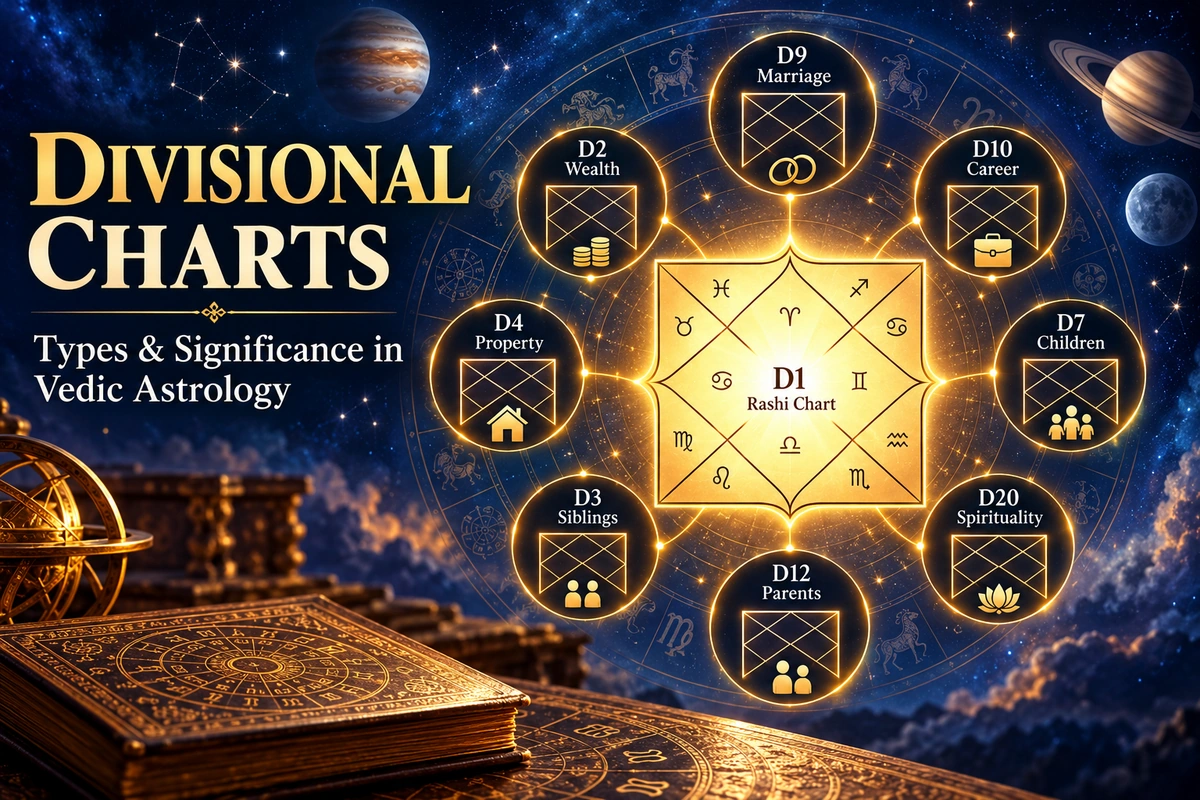
In Vedic astrology, the birth chart is only one part of a detailed horoscope analysis. Astrologers also study divisional charts, known as Varga Kundli, to understand specific areas of life, such as marriage, career, finances, children, property, and spirituality.
Each divisional chart examines the birth chart from a different perspective. While the D1 chart, or Rashi chart, provides an overall picture of life, charts such as the D9 Navamsa and D10 Dashamsa help astrologers explore particular subjects in greater detail.
Understanding these charts can help you learn how Vedic astrology approaches different life questions and why astrologers often examine multiple charts before interpreting a horoscope.
What Are Divisional Charts in Vedic Astrology?
Divisional Charts are derived from the main birth chart by the division of the twelve zodiac signs to subdivide into a small sector, as per the norms of traditional Vedic Astrology. Each division of the Zodiac gives rise to a chart indicating that particular aspect of life.
The divisional charts are also known as Vargas. Various Vargas indicate various aspects of human life such as relationships, career, money, family, spiritual advancement, etc.
For instance, a common use of D9 chart is for the study of marriage and relationships, whilst D10 chart would provide relevant information about profession and career.
Still, divisional charts should not be interpreted in isolation as astrologers would normally take into account the D1 birth chart, position of planets, lords of the house, yogas, Dashas, etc.
What Is the Difference Between the D1 Chart and Divisional Charts?
The D1 chart, also known as the Lagna chart or Rashi chart, is the foundation of a Vedic horoscope. It provides a broad view of personality, life circumstances, relationships, career, finances, and other major themes.
Divisional charts offer a more focused perspective on selected areas.
- D1 Chart: Overall life patterns, personality, and the broader promise of the horoscope.
- D9 Navamsa Chart: Marriage, relationships, dharma, and planetary strength.
- D10 Dashamsa Chart: Career, profession, status, and work-related responsibilities.
- D2 Hora Chart: Wealth, financial resources, and the capacity to manage material assets.
The purpose of a divisional chart is not to replace the birth chart but to add another layer of interpretation. A meaningful reading considers whether the indications in the relevant divisional chart are supported by the D1 chart and other astrological factors.
Types of Divisional Charts and Their Significance
Different divisional charts are associated with different subjects in traditional Vedic astrology. Explore the guides below to understand what each chart represents and how astrologers interpret it.
1. Navamsa Chart (D9): Marriage & Destiny
The Navamsa is one of the most commonly used divisional charts in Vedic astrology, used primarily for a person’s marital status and relationships. Astrologers analyze the Navamsa Lagna, 7th house, 7th lord, Venus, Jupiter, and planetary status in order to give one an idea of their relationship.
Explore: Navamsa Chart (D9)
2. Dashamsa Chart (D10): Career & Profession
The D10 chart relates to career, public image, authority, and responsibilities. Career-related information can be gained by combining this chart with the D1 chart.
When looking at interpretations of the Dashamsa chart, astrologers typically analyze the tenth house and its lord.
Explore: Dashamsa Chart (D10)
3. Hora Chart (D2): Wealth & Finance
The D2 chart is used in fortune and material wealth interpretation. Planetary placements as well as their interaction with the natal chart are commonly considered during the Hora chart examination.
This chart can come in handy when analyzing finances, but it is not a financial guarantee.
Explore: Hora Chart (D2)
4. Saptamsa Chart (D7): Children & Progeny
The Saptamsa chart refers to children and related family issues. It can be analyzed along with the fifth house and Jupiter.
The above-mentioned chart cannot substitute medical diagnosis of fertility.
Explore: Saptamsa Chart (D7)
5. Chaturthamsa Chart (D4): Property & Assets
Astrologers relate the D4 chart to home, property, real estate, immovable assets, stability at the household level, and some forms of material security. This chart is useful during inquiries concerning the person’s home, property, etc.
Astrologers also take into account the chart together with the fourth house and its lord in the D1 chart.
Explore: Chaturthamsa Chart (D4)
6. Drekkana Chart (D3): Siblings & Courage
The Drekkana chart also tells astrologers about siblings, courage, initiative, and attempts to overcome barriers.
The third house and its lord in the D1 chart have great importance in this matter as well.
Explore: Drekkana Chart (D3)
7. Dwadashamsa Chart (D12): Parents & Ancestry
Astrologists relate the D12 map to parents, lineage, ancestry, household roots, and family-related life issues. The analysis can be made much more profound by combining D12 with the relevant houses and planets keys within the D1 map
Explore: Dwadashamsa Chart (D12)
8. Vimshamsa Chart (D20): Spirituality & Worship
Astrologists assess the Vimshamsa map in issues of spirituality in a broader context as well as religiosity of the person. Thus, the chart can be used in determining the person’s interests in spiritual matters and spiritual activities.
Explore: Vimshamsa Chart (D20)
How Are Divisional Charts Calculated?
Divisional charts are calculated using planetary longitudes in the birth chart. Each zodiac sign spans 30 degrees, which is divided according to the rules of the particular Varga.
The number in a chart’s name indicates its division. For instance, D9 divides each sign into nine parts, while D10 divides it into ten parts. The method used to assign planets and signs to the resulting chart varies according to the divisional system.
Accurate birth details are important because planetary positions and the Ascendant depend on the recorded date, time, and place of birth. Even a small difference in birth time can affect the Ascendant and some divisional chart placements.
How Should You Read a Divisional Chart?
A divisional chart is best understood as part of a complete horoscope analysis. Astrologers commonly consider the following factors:
- D1 chart: The broader indications and overall context of the horoscope.
- Relevant divisional chart: The life area being examined, such as marriage or career.
- Lagna and house lords: Their placements, dignity, and connections.
- Planetary strength: Sign placement, aspects, conjunctions, and other traditional strength indicators.
- Dashas and transits: Their potential relevance to the timing of developments.
Explore Varga Kundli with GaneshaSpeaks
Divisional charts add value to Vedic astrology by contributing to the understanding of its principles through detailed interpretations that cover different subjects and aspects of one’s life. For instance, the D9 chart highlights information about relationships and marital life; D10 deals with career and professional endeavors; D20 focuses on religious life, etc.
And at GaneshaSpeaks, we have expert Vedic astrologers who practice traditional techniques of Vedic astrology to interpret both the natal and the divisional charts.
Would you like to understand the things divisional charts can tell about your astrological life?
FAQs
What are Divisional Charts in Vedic Astrology?
Divisional charts, also known as Varga Kundli, are used in Vedic astrology to analyze specific areas of life such as marriage, career, and finances. They are derived from the main birth chart by dividing the twelve zodiac signs into smaller sectors, providing a focused perspective on selected life aspects.
How is the Navamsa Chart (D9) used in Vedic Astrology?
The Navamsa Chart (D9) is primarily used to study marriage and relationships. Astrologers analyze the Navamsa Lagna, 7th house, 7th lord, Venus, Jupiter, and planetary status to give insights into a person’s marital status and relationships.
What information does the Dashamsa Chart (D10) provide?
The Dashamsa Chart (D10) relates to career, public image, authority, and responsibilities. It provides career-related information by analyzing the tenth house and its lord, often in combination with the D1 chart.
Why should divisional charts not be interpreted in isolation?
Divisional charts should not be interpreted in isolation because they are meant to add another layer of interpretation to the D1 birth chart. A meaningful reading considers whether the indications in the relevant divisional chart are supported by the D1 chart and other astrological factors.
What is the purpose of the Hora Chart (D2) in Vedic Astrology?
The Hora Chart (D2) is used to analyze wealth and finance in Vedic astrology. It provides insights into a person’s financial status and potential for wealth accumulation.