


Rahu and Ketu Axis: Meaning, Effects, Personality & All 12 Houses
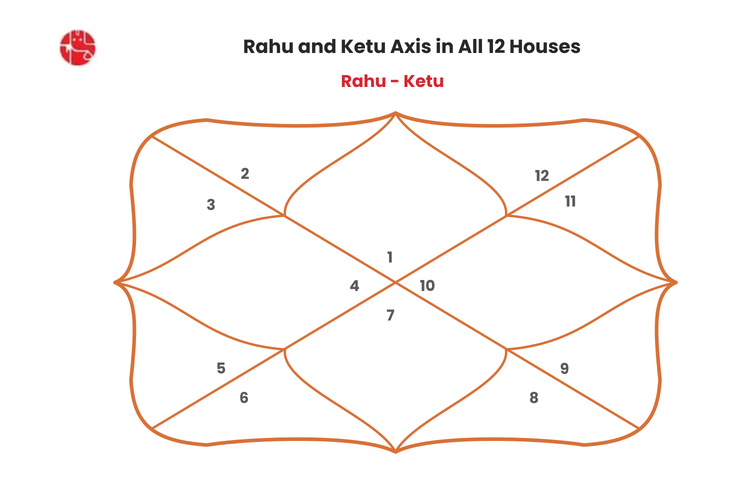
Rahu and Ketu are the lunar nodes in Vedic astrology and are always positioned opposite each other in a birth chart. Rahu is associated with ambition, desire, worldly experiences, experimentation and the urge to achieve more, while Ketu represents detachment, spirituality, intuition and the search for deeper meaning. Together, they form the Rahu-Ketu axis, highlighting the balance between material desires and inner growth.
This axis can show where a person feels strongly driven to experience, achieve or explore, and where they may naturally feel detached or inward-looking. Results depend on the signs, houses, planetary aspects, house lordship and Mahadasha or Antardasha.
What is the Rahu and Ketu Axis?
Rahu and Ketu are opposite points in the birth chart and always occupy houses that are 180 degrees apart. Rahu pulls attention toward worldly experiences, ambition and unfamiliar territory, while Ketu encourages detachment from areas that may already feel familiar or less satisfying.
This creates an important life axis. The Rahu side often shows where a person wants to grow through experience, while the Ketu side can indicate areas where they seek freedom, simplicity or deeper understanding.
The axis also moves in transit, spending about 18 months in each pair of signs. In late 2026, the nodes change signs, with Rahu moving from Aquarius to Capricorn and Ketu moving from Leo to Cancer, which shifts the houses this axis activates in every chart.
Key Effects of Rahu and Ketu Axis
- Strong ambition and desire for growth
- Attraction toward unfamiliar experiences
- Intuitive and observant nature
- Interest in spirituality or hidden subjects
- Ability to adapt to unusual circumstances
- Periods of dissatisfaction despite achievements
- Tension between material goals and inner peace
- Independent thinking and unconventional choices
- Strong karmic themes in the connected houses
- Important life lessons through balance and detachment
Benefits of the Rahu and Ketu Axis
The Rahu-Ketu axis may inspire individuals to venture into vast new domains, while at the same time contemplating their inner selves in new ways. With Rahu, it is possible to experience a sense of stimulation associated with advances in technology, foreign contacts, research, entrepreneurship and original job opportunities. Ketu will allow the person to develop the skills of intuition, specialized knowledge, spiritual interests and independence.
Is the Rahu-Ketu axis affecting your relationships? Get Your Relationship Compatibility Report
Challenges of the Rahu and Ketu Axis
The imbalanced axis may cause difficulties in distinguishing between one’s desires and what gives real satisfaction. Rahu can boost a person’s restlessness, obsession and strong ambition while Ketu will allow for detachment, withdrawal and indifference.
Rahu and Ketu Axis in 1st and 7th Houses
The fact that Rahu is present in the first house signifies the need to focus on personality attributes and characteristics as well as self-improvement processes. Ambition and aspiration for achievements can be also regarded as a result of Rahu’s influence. Ketu in the seventh house makes it possible to find out about all kinds of partnership and relationship problems. Nevertheless, communication plays a major role in finding the balance between freedom and commitment in any relationship type.
Rahu and Ketu Axis in 2nd and 8th Houses
Rahu’s being in the second house indicates a strong attraction to wealth, family values, speech, and safety in finances. Ketu in the eighth house leads to various inclinations towards the studying of mysticism, scientific research, and psychology. At this stage of life, it is important to start following the principles of responsible and transparent usage of resources.
Rahu and Ketu Axis in 3rd and 9th Houses
With Rahu in the third house, one can facilitate courageous communication, writing, networking, and entrepreneurial activities. Ketu being located in the ninth house makes one doubt many important beliefs and creates their own philosophy. Traveling can lead to new knowledge obtained from higher education and spiritual exploration.
Rahu and Ketu Axis in 4th and 10th Houses
As for Rahu in the fourth house, it can lead to strong ambition related to the home, real estate, comfort, or emotional safety. Meanwhile, Ketu in the tenth house can trigger withdrawal from the conventional career path. So the person may prefer to engage in any professional fulfillment that is meaningful or out of the ordinary instead of just chasing after social status.
Rahu and Ketu Axis in 5th and 11th Houses
Rahu present in the fifth house can make the individual more interested in creativity, love, entertainment, gambling or gaining fame. In turn, if Ketu lies in the eleventh house, the person may be rather fussy about friends and social circles. They may gain in an unusual way, though achieving emotional contentment due to popularity and social validation may not be guaranteed.
Rahu and Ketu Axis in 6th and 12th Houses
With Rahu positioned in the sixth house, one of the results may be the emergence of a rivalry instinct and a desire to resolve complex situations. This location of Rahu can provoke involvement in some technical, medical, governmental, legal, or investigative activities. Ketu in the twelfth house nurtures greater interest in spirituality, meditation, faraway lands, and solitude while continuing to support a healthy lifestyle.
Rahu and Ketu Axis in 7th and 1st Houses
Rahul in the seventh house may lead to considerable focus on partnership relations, any types of cooperation, business ties, or people of different national origins. Ketu in the first house may lead to greater introspection and less conventional issues. In this light, relationship emergence may play a significant role in self-discovery.
Rahu and Ketu Axis in 8th and 2nd Houses
Rahu in the eighth house may lead to growing interest in psychology, research, esoteric subjects, taxation, insurance, and hidden systems of all kinds. The presence of Ketu in the second house may help a person cultivate detachment from predetermined family values and material prosperity.
Rahu and Ketu Axis in 9th and 3rd Houses
Rahu in the 9th can encourage foreign travel, unconventional education, philosophy and exploration of different belief systems. Ketu in the 3rd may make communication more selective and independent. The person may prefer depth over constant social interaction.
Rahu and Ketu Axis in 10th and 4th Houses
Rahu in the 10th house can give an emphasis on career, status, leadership and accomplishments in public. It establishes a solid basis for ambitious ideas and unconventional profession choices. Ketu in the 4th house is associated with emotional alienation of one’s home or desire for simple household arrangement.
Rahu and Ketu Axis in 11th and 5th Houses
Rahu in the 11th house may be interpreted as increased interest in all kinds of organization – structures, connections, any sort of profit and long-term targets. Ketu in the 5th house gives a more detached view to matters of love, recognition and creative self-expression.
Rahu and Ketu Axis in 12th and 6th Houses
Rahu in the 12th house indicates increased interest in foreign countries, spirituality, private work, imagination and experiences of anything unusual. Ketu in the 6th house suggests a lower level of competitiveness. It is important to make practical work easier so that too much introspection does not lead to social isolation.
Remedies for Rahu and Ketu
Traditional Vedic astrology practices may include:
- Chant Om Rahave Namah for Rahu and Om Ketave Namah for Ketu.
- Worship Lord Ganesha and seek guidance from experienced mentors.
- Practise meditation and maintain a disciplined daily routine.
- Donate food or useful items to people in need.
- Avoid impulsive decisions driven by fear, obsession or excessive desire.
- Keep relationships, finances and professional responsibilities transparent.
Unlock the True Meaning of the Rahu-Ketu Axis
Rahu-Ketu is an important point of balance between desire and dispassion, experience and development. Rahu favors ambition and venturing out into the world. Ketu, on the other hand, supports letting go and contemplation. The houses involved show the field where this more or less contradictory tendency operates. However, to make these indicators meaningful one has to take into account the whole natal chart with all its planets, their strength, aspects and the current Mahadasha or Antardasha.
Want to know which houses the Rahu-Ketu axis occupies in your chart? Talk to an Astrologer – First Chat Free!
FAQs
What is the Rahu and Ketu Axis?
The Rahu and Ketu Axis refers to the positions of the lunar nodes in Vedic astrology, which are always opposite each other in a birth chart. Rahu is associated with ambition and worldly experiences, while Ketu represents detachment and spirituality.
How do Rahu and Ketu affect personality?
Rahu influences personality by driving ambition, desire, and the urge to explore new experiences. Ketu, on the other hand, fosters detachment, intuition, and a search for deeper meaning, affecting one’s inner growth and spiritual journey.
What are the effects of Rahu in the first house?
Rahu in the first house often signifies a focus on self-improvement, personality development, and ambition. It can lead to a strong desire for achievement and recognition in personal attributes.
What does Ketu in the seventh house indicate?
Ketu in the seventh house can indicate challenges in partnerships and relationships, promoting introspection and a deeper understanding of personal freedom versus commitment.
How does the Rahu-Ketu axis impact career choices?
The Rahu-Ketu axis influences career choices by encouraging exploration and ambition through Rahu, while Ketu may lead to unconventional paths and a search for meaningful professional fulfillment beyond social status.