



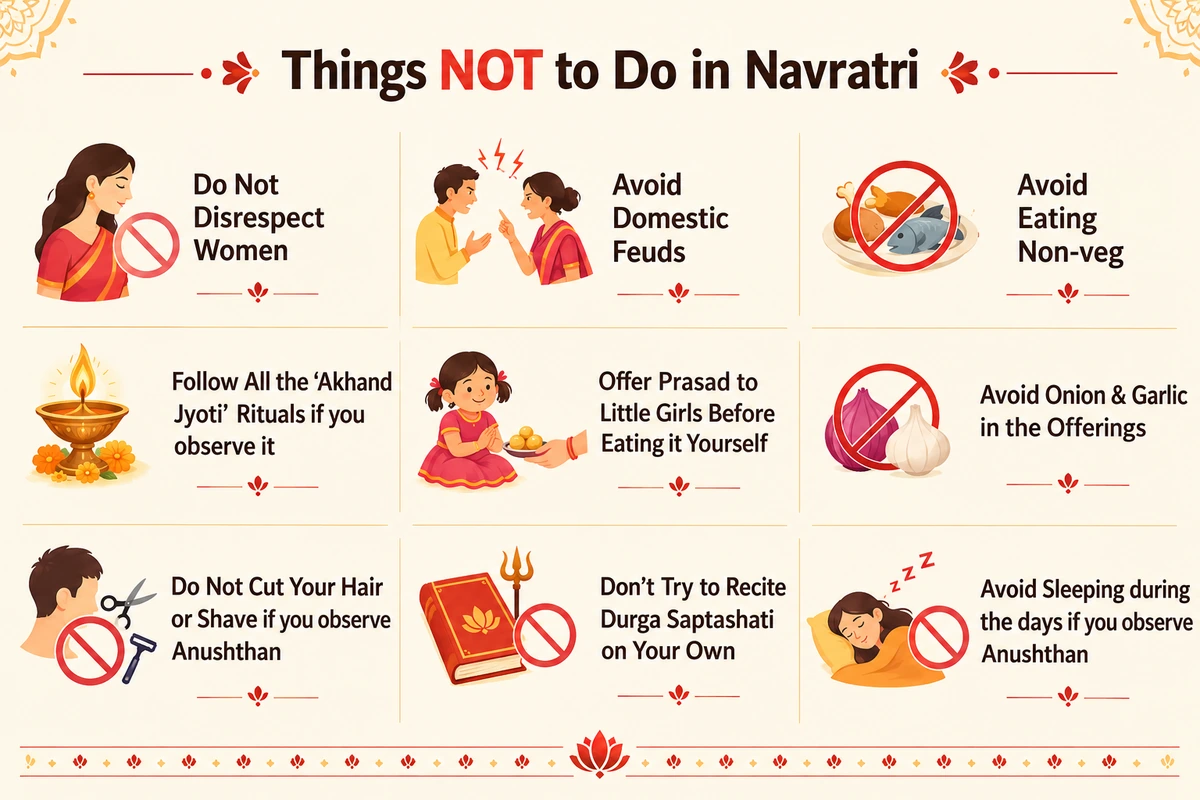
During Navratri, devotees avoid onion, garlic and non-vegetarian food, follow a Satvik diet, never leave the Akhand Jyoti unattended, and read the Durga Saptashati with care and reverence. Kanya Pujan is done on Ashtami (19 October) or Navami (20 October). Not every rule is compulsory, so most families follow these according to their own traditions.
Navratri is not just about fasting, temple visits, or Garba celebrations. Navratri – which is dedicated to Goddess Durga and her nine avatars – tells us the significance of mindful living, eating, behaviour, thoughts, and spiritual practices. However, along with praying, a few things are also kept in mind to avoid any interference during the celebration of this festival.
If you’re observing a fast (vrat) during this Navratri or are following special rituals, there are a few important things you should know.
Shardiya Navratri 2026 Calendar: Dates, Goddesses and Colours
| Day | Date | Tithi | Goddess | Colour |
|---|---|---|---|---|
| Day 1 | Sunday, 11 Oct 2026 | Pratipada (Ghatasthapana) | Maa Shailputri | Orange |
| Day 2 | Monday, 12 Oct 2026 | Dwitiya | Maa Brahmacharini | White |
| Day 3 | Tuesday, 13 Oct 2026 | Tritiya | Maa Chandraghanta | Red |
| Day 4 | Wednesday, 14 Oct 2026 | Chaturthi | Maa Kushmanda | Royal Blue |
| Day 5 | Thursday, 15 Oct 2026 | Panchami | Maa Skandamata | Yellow |
| Day 6 | Friday, 16 Oct 2026 | Shashthi | Maa Katyayani | Green |
| Day 7 | Saturday, 17 Oct 2026 | Saptami (Maha Saptami) | Maa Kaalratri | Grey |
| – | Sunday, 18 Oct 2026 | Saptami continues; Ashtami begins 08:29 AM | – | – |
| Day 8 | Monday, 19 Oct 2026 | Ashtami (Durga Ashtami) | Maa Mahagauri | Purple |
| Day 9 | Tuesday, 20 Oct 2026 | Navami (Maha Navami) | Maa Siddhidatri | Peacock Green |
| Dussehra | Tuesday, 20 Oct 2026 | Dashami begins 12:51 PM | Vijayadashami | – |
Are You Facing any Problems in Life? So, this is the right time to Connect with our Astrologer on Chat and remove your obstacles. First Chat Free!
1. Do Not Disrespect Women
During Navratri, we worship goddess Shakti and her incarnations. So one of the most important values attached to Navratri is to honour and respect women.
This respect must be shown not only in temples and on religious occasions, but also at the workplace, in our homes and lives. When we respect our mothers, daughters, and sisters, we are respecting Shakti – this helps us uphold the spirit of Shakti.
2. Avoid Arguments and Conflicts at Home
Worship during Navratri is generally conducted to bring about a calm and spiritually positive ambiance.
On these days, you are suggested to avoid any unwanted fights and rather choose to speak peacefully. You can have disagreements with people at home or with people outside your home, but remain peaceful and patient. A happy and peaceful home will enable you to focus on your prayers, meditation, and other religious activities.
3. Avoid Non-Vegetarian Food
Some devotees follow a vegetarian, Satvik (vegetarian) diet during the Navratri fasting.
Meat, fish, and eggs are excluded by everyone who follows these practices; some, however, include additional restrictions according to their family custom and nature of fast.
The meaning of Satvik eating is easy, simple, moderate, and self-control. But Navratri foods differ from state to state.
4. Do Not Neglect Akhand Jyoti Rules
Lighting the Akhand Jyoti, the flame that can stay alive for nine days, is one of the Navratri traditions that is a common sight in each house.
The one who performs this puja normally keeps the flame burning for the duration of this worship. You need to position the lamp in a safe location, such as a tile, glass table, etc., and keep it at least some distance away from curtains or anything else that is combustible.
5. Do Not Overlook Kanya Pujan
Kanya Pujan is an auspicious ritual performed during worship of the divine feminine.
Mostly, the pooja is performed on Ashtami or Navami in families. The devotees call the young girls of the house, offer them food and prasad, and seek their blessings.
Prasad should be given to the young girls before you eat it. If this custom is observed, it is a gesture of regard and reverence to Maa Durga.
6. Avoid Onion and Garlic in Puja Offerings
In most homes, the food given to Maa Durga is made in the Satvik way. Thus, onion and garlic are usually not included in Navratri Bhog & Prasad.
Offerings of fresh fruits, milk, nuts, and grains are usually made by devotees. The components of the offering may change according to the Puja and the customary fasting followed.
7. Avoid Haircuts and Shaving During Anusthan
Some Vaishnavas observe Anusthan where they fast, do prayers, and chant mantras.
In order to practice self-control, hair cutting and shaving are always prohibited in such occurrences.
This limitation is usually related to those who have made a certain religious vow. It should not be taken as a general requirement for everyone celebrating Navratri.
8. Do Not Recite Durga Saptashati Carelessly
Saptashati Durga or Devi Mahatmya is a sacred text dedicated to the Goddess and contains 700 verses describing her and her victories over destructive energies.
Followers who recite this formally pay careful attention to pronunciation, sequence, and prescribed procedures.
For the less experienced, consult a priest or teacher who knows the scripture. The idea is to read the holy text with clarity, reverence, sincerity, and respect.
9. Avoid Daytime Sleeping During Strict Anusthan
There are some Anusthan traditions where the devotees are told not to sleep in the daytime.
It is believed that the devotees should stay vigilant and devoted to prayer, mantra reciting, and spiritual values.
And this does not necessarily hold true for everyone observing Navratri. Proper sleep and rest are necessary for people fasting, older persons, and people with health issues.
Are All Navratri Rules Compulsory?
Some rules are not mandatory for all. Different regions follow different customs, especially when it comes to family customs and the type of Vrat/Anusthan performed.
Some individuals practice fasting the entire nine days, some on specific days, and some mainly by praying and temple visits.
It is much better to have an understanding of the reason for a tradition than to merely have the restriction.
Will 2027 be a year of strength or stress? Get Your Detailed Report Now!
Celebrating Navratri with Faith and Discipline
Navratri rituals help you develop devotion, control of your senses, and give you a better understanding of your actions.
The restriction of foods and prescribed fasting is just one aspect of Navratri. The other is kindness and respect. Be it observing strict fasting or performing daily prayers, Navratri is an auspicious time for you to be closer to Maa Durga.
While the traditions may vary from one household to another, the spirit of devotion is constant.
FAQs
What are the 9 things you should not do during Navratri 2026?
During Navratri 2026, avoid consuming meat, fish, and eggs, refrain from negative thoughts and actions, avoid using harsh language, do not disrespect women, refrain from alcohol and tobacco, avoid wearing black, do not cut your hair or nails, avoid sleeping during the day, and do not engage in unnecessary arguments.
Why is it important to respect women during Navratri?
Respecting women during Navratri is crucial as the festival honors Goddess Durga and her nine avatars, symbolizing Shakti. By respecting women, we uphold the spirit of Shakti, which is a fundamental value of the festival.
What is the significance of lighting the Akhand Jyoti during Navratri?
Lighting the Akhand Jyoti during Navratri symbolizes the eternal flame of devotion and is a common tradition in households. It is kept burning for the entire duration of the festival as a mark of spiritual dedication.
What dietary practices are followed during Navratri fasting?
During Navratri fasting, devotees follow a Satvik diet, which is vegetarian and excludes meat, fish, and eggs. The diet emphasizes simple, moderate, and self-controlled eating, varying slightly by regional customs.
What is Kanya Pujan and when is it performed?
Kanya Pujan is a ritual performed on Ashtami or Navami during Navratri. It involves worshipping young girls, offering them food and prasad, and seeking their blessings, symbolizing the worship of the divine feminine.