



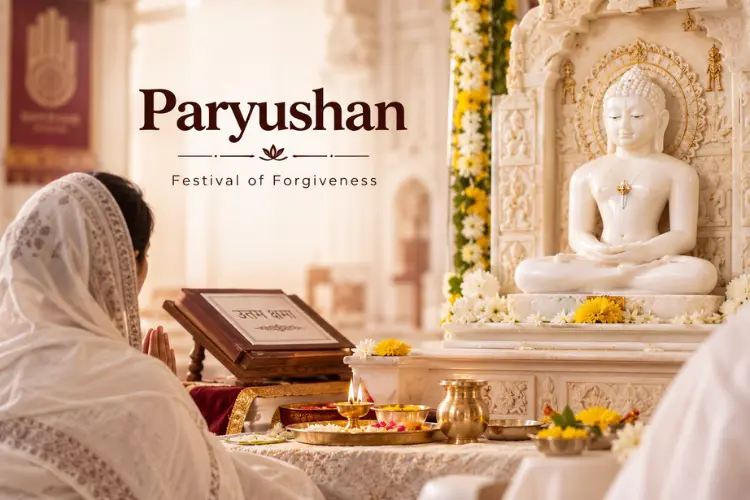
What if the most important Jain festival is not about celebration, but about stopping, reflecting and asking for forgiveness? Paryushan is a sacred period of fasting, self-discipline, Pratikraman and spiritual reflection observed by Jain communities. It encourages people to look inward, reduce attachment and anger, and consciously work towards purification of the soul.
In 2026, Shvetambar Jains will observe Paryushan Parva from Tuesday, September 8 to Tuesday, September 15, with Samvatsari on September 15. Digambar Jains observe the related Das Lakshan Parva from September 16 to September 25, followed by their forgiveness observance.
Paryushan 2026 Dates and Timings
Paryushan follows the Jain lunar calendar, so its dates change every year. The observance also differs between Shvetambar and Digambar traditions.
| Details | Date |
|---|---|
| Shvetambar Paryushan (8 days) | Tuesday, 8 September to Tuesday, 15 September 2026 |
| Samvatsari | Tuesday, 15 September 2026 |
| Digambar Das Lakshan Parva (10 days) | Wednesday, 16 September to Friday, 25 September 2026 |
| Anant Chaturdashi | Friday, 25 September 2026 |
According to a Jain calendar, the date of Paryushan Parvarambha is on 8 September along with Krishna Dwadashi, which lasts till about 2.42 PM in New Delhi time. Samvatsari is on 15 September along with Shukla Chaturthi, which lasts till about 7:44 AM. Because of variations in tithi timings, devotees must check the tithi maintained by their respective local Sangh.
What Is Paryushan?
Paryushan is one of the most important times in the Jain calendar. It means “to come close” and involves reflecting on oneself in a spiritual manner.
Instead of being concentrated on external celebrations, Paryushan prescribes fasting, Pratikraman, self-study, mediation, control over oneself, and forgiveness. Devotees can reduce their food intake or break fast in various ways depending on their own capability of carrying out fast.
For Shvetambar Jains, the fifteen days end up with Samvatsari, which is considered the most important day of Paryushan, during which believers think over their actions committed over the year and mobilize a request for forgiveness to all living things of the world.
Why Is Paryushan Celebrated?
The essence of the Paryushan festival consists of self-purification and spiritual progress. The teachings of Jainism imply suppression of the destructive feelings of human beings like anger, pride, and deceit that block one’s way to liberation.
During this period, people do not just omit the consumption of food but use this time for serious consideration of their behavior; thus, they are more engaged in religious practices than ever.
The above-mentioned facts explain why the occasion provides invaluable opportunities for self-discipline and self-reflection.
Paryushan Rituals and Practices
The specific practices can differ according to sect, Sangh and individual capacity, but several observances are central to Paryushan.
1. Fasting and Austerity
Fasting is an important part of Paryushan. Some devotees observe extended fasts, while others follow simpler forms of dietary restraint. The purpose is to practise self-control and reduce attachment to physical comforts.
2. Pratikraman
An important element of Jain religious practice is pratikraman, a structured exercise of analyzing one’s actions, acknowledging one’s mistakes and feeling sorry for them. During Paryushan, followers concentrate on this process, looking back to see how they hurt others using their thoughts, words or actions.
3. Swadhyaya and Religious Discourses
Many devotees use this period to further their knowledge of Jain scriptures. For the Shvetambar community, the Kalpa Sutra takes special significance during the period of Paryushan. This book is read and explained as part of the religious ceremonies.
4. Meditation and Self-Reflection
Meditation, silence and contemplation allow devotees to understand themselves better. The emphasis is on the understanding of one’s own behavior and the eventual ability to control their feelings and desires.
5. Samvatsari Pratikraman
The last day of the festival is called Samvatsari. On that day, the Samvatsari Pratikraman is performed, when followers think back on their deeds and ask others to forgive them.
Published 2026 programmes show Samvatsari Pratikraman scheduled in the afternoon and extending into the evening, although the exact timing varies between Sanghs.
Samvatsari 2026 and Micchami Dukkadam
Samvatsari will be observed on Tuesday, September 15, 2026, for the Shvetambar tradition. It is widely known as the day of forgiveness.
After reflecting on their conduct and performing Pratikraman, Jains seek forgiveness from others by saying “Micchami Dukkadam”, expressing the wish that any harm caused knowingly or unknowingly be forgiven.
The practice is not limited to a formal ritual. It represents the Jain ideal of resolving resentment, accepting responsibility and repairing relationships.
Paryushan and Das Lakshan: What Is the Difference?
Primarily, Paryushan is celebrated by the Shvetambars, while Das Lakshan Parva, a ten-day religious event, is observed by the Digambars.
For instance, in the year 2026, Shvetambar Paryushan concludes with Samvatsari on September 15 while Das Lakshan begins on September 16 and continues till September 25. These ten days focus on the ten noble virtues such as forgiveness and modesty, candor, truth and purity, etc.
In essence, both events shouldn’t be looked upon as mere festivals having different timings. These celebrations are unique in their own sense and enrich people’s lives through spiritual practices and self-examination.
Paryushan 2026: A Festival of Forgiveness
Paryushan presents a unique inquiry: Is it possible to achieve betterment through the honest assessment of our actions?
Through methods centered on humility, moderation and forgiveness, the answer could be found. The followers of the Shvetambara sect direct their efforts toward self-improvement and spirituality for eight days and come to the conclusion of Samvatsari and the custom of asking for forgiveness.
In 2026, the celebration of Paryushan will be held again, giving the Jain families another chance to interrupt the rhythm of routine life and return to Ahimsa and the sense of self-discipline, compassion, and forgiveness.
Performing fasts, practicing Pratikraman ceremonies, studying scriptures and just reflecting on one’s actions, no matter how one chooses to celebrate Paryushan, the most important goal of this celebration is to overcome negativity and gain spiritual awareness.
FAQs
What are the dates for Paryushan Parv in 2026?
In 2026, Shvetambar Jains will observe Paryushan Parva from Tuesday, September 8 to Tuesday, September 15, with Samvatsari on September 15. Digambar Jains will observe the related Das Lakshan Parva from September 16 to September 25.
What is the significance of Paryushan Parv?
Paryushan Parv is a sacred period of fasting, self-discipline, Pratikraman, and spiritual reflection observed by Jain communities. It encourages people to look inward, reduce attachment and anger, and work towards purification of the soul.
What are the main rituals observed during Paryushan?
The main rituals during Paryushan include fasting, Pratikraman, self-study, meditation, and seeking forgiveness. These practices help devotees engage in self-discipline and spiritual reflection.
How does fasting differ during Paryushan?
Fasting during Paryushan can vary based on individual capability. Some devotees observe extended fasts, while others follow simpler forms of dietary restraint to practice self-control and reduce attachment to physical comforts.
What is the role of Pratikraman in Paryushan?
Pratikraman is an important element of Jain religious practice during Paryushan. It involves analyzing one’s actions, acknowledging mistakes, and feeling sorry for them, focusing on how one may have hurt others through thoughts, words, or actions.