



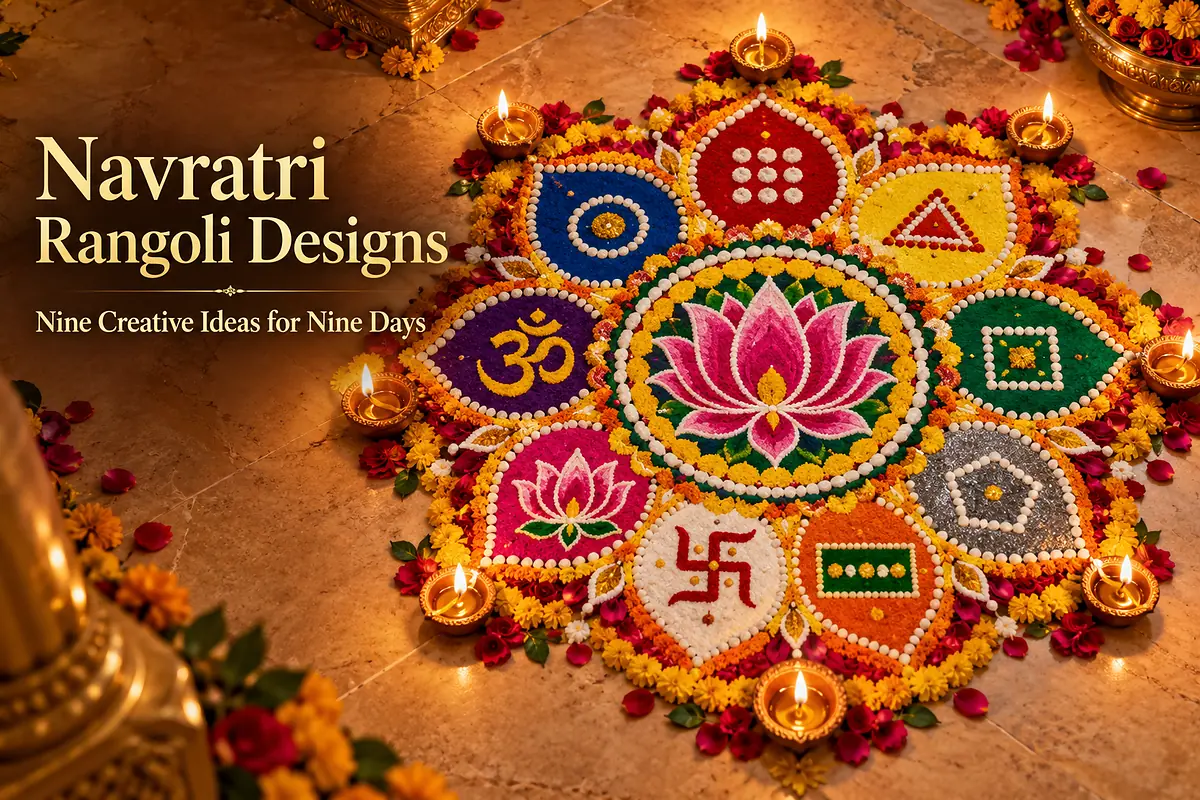
Navratri rangoli designs can match each day of the festival, which begins on 11 October 2026. Ideas include a simple dot rangoli for Maa Shailputri, a circular design for Maa Brahmacharini, and a lotus for Maa Mahagauri on Durga Ashtami. The festival ends with an Om rangoli for Maa Siddhidatri. Sketch the design in chalk first, then fill it with coloured powder, flower petals or rice paste (Alpana).
A colourful Rangoli at the entrance can give your house a festive look in no time. During Navratri, this is one of the things that is used in the preparations to welcome Maa Durga. You can go for simple Rangoli designs using coloured powders or with flowers, diyas, and religious symbols.
Rangoli is not just a decorative art form. For many Indian households, making one at the entrance or in the Puja area is considered an auspicious way of welcoming guests and marking a religious occasion. Navratri gives a plethora of ideas for creating unique designs since it features nine days dedicated to nine incarnations of Goddess Durga.
The following nine Rangoli ideas combine traditional shapes, festive colours, and symbolic elements that can be used every day to mark the celebration.
Shardiya Navratri 2026 Calendar: Dates, Goddesses and Colours
| Day | Date | Tithi | Goddess | Colour |
|---|---|---|---|---|
| Day 1 | Sunday, 11 Oct 2026 | Pratipada (Ghatasthapana) | Maa Shailputri | Orange |
| Day 2 | Monday, 12 Oct 2026 | Dwitiya | Maa Brahmacharini | White |
| Day 3 | Tuesday, 13 Oct 2026 | Tritiya | Maa Chandraghanta | Red |
| Day 4 | Wednesday, 14 Oct 2026 | Chaturthi | Maa Kushmanda | Royal Blue |
| Day 5 | Thursday, 15 Oct 2026 | Panchami | Maa Skandamata | Yellow |
| Day 6 | Friday, 16 Oct 2026 | Shashthi | Maa Katyayani | Green |
| Day 7 | Saturday, 17 Oct 2026 | Saptami (Maha Saptami) | Maa Kaalratri | Grey |
| – | Sunday, 18 Oct 2026 | Saptami continues; Ashtami begins 08:29 AM | – | – |
| Day 8 | Monday, 19 Oct 2026 | Ashtami (Durga Ashtami) | Maa Mahagauri | Purple |
| Day 9 | Tuesday, 20 Oct 2026 | Navami (Maha Navami) | Maa Siddhidatri | Peacock Green |
| Dussehra | Tuesday, 20 Oct 2026 | Dashami begins 12:51 PM | Vijayadashami | – |
Are You Facing any Problems in Life? So, this is the right time to Connect with our Astrologer on Chat and remove your obstacles. First Chat Free!
Why Is Rangoli Made During Navratri?
Rangoli has been an age-old traditional art in India. Rangoli is often made at the entrances and courtyards of temples at the time of festivals to welcome people.
In Navratri, people paint rangoli on the floor of their houses and organise a celebration or Puja by inviting family members. Rangoli brings colour to these places.
Various regions have various customs. In some regions, individuals paint white rice paste designs on the ground, called Alpana, on the occasion of Durga Puja. Elsewhere, individuals draw geometric designs or utilize coloured powders, plant petals, and such.
Nine Rangoli Designs for the Nine Days of Navratri
Day 1 – Red and White Rangoli for Maa Shailaputri
Start your Navaratri festivities with this simple Rangoli pattern.
Simply place a string of red dots to make a line, then encircle them with a border of white. The red colour represents strength and commitment, and white adds a little contrast.
With this design, the red dots can be positioned as a circle or a flower. It looks nice when kept close to the entrance puja area or main door.
Day 2 – Circular Rangoli for Maa Brahmacharini
On the second day, design the rangoli in a circular pattern using royal blue as the dominant colour.
Start by creating just one small circle, then continue to use dots, curved lines, or petal shapes to make it interesting. You can also use more circles after the first one.
You can also take inspiration from a circular design and fill the space for designing if you are short on space. Maa Brahmacharini represents devotion and control, and this clean rangoli design goes really well with the centred energy of the god.
Day 3 – Triangular Rangoli for Maa Chandraghanta
A triangular rangoli with yellow dots could be a good choice for the third day.
Make a big triangle and fill the blank spaces with small figures by using white colour for outlining and yellow for filling.
Keep some diyas around it; if there is a place for them, they will look nice and create a warm atmosphere, especially in the evening when people will come to pray.
Day 4 – Square Rangoli for Maa Kushmanda
On Chaturthi, make a square rangoli; fill the centre with green and the border with yellow or orange.
It’s best suited for small doorways and corners, as you can split the square into four and fill each with leaves, flowers, or mirror-image shapes.
The lime provides a modern touch, and orange and yellow bring in some warmth.
Day 5 – Pentagon Rangoli for Maa Skandamata
Use a less common shape for your Panchami creation, like the five-sided Rangoli. Make sure to fill the inside with grey powder, and use blue for the borders.
Floral patterns or white dots can also enhance the appeal of the design. If you find it hard to draw five equal sides, first trace them lightly with chalk on the ground.
Day 6 – Orange and Green Rangoli for Maa Katyayani
The sixth day is a good chance to make a bright Rangoli with orange and green colours.
Make a rectangle and decorate it with dots in different colours in alternating lines. You can also use leaf shapes and small flowers for decoration.
It is best to use this design in the doorway, as this shape can be adapted to any size available in the desired location.
Day 7 – Swastik Rangoli for Maa Kaalratri
On Maha Saptami, people can make a traditional Swastik Rangoli with the help of white powder. For this purpose, one can use red or another dark colour to outline it.
Actually, the Swastik is an ancient symbol of good luck and prosperity in Hinduism. You should draw it carefully and put it in a place where it cannot be destroyed.
In addition, one can fill it with small flowers to complete the pattern.
Day 8 – Lotus Rangoli for Maa Mahagauri
Lotus Rangoli is suitable for Durga Ashtami.
Pink colour for the petals, white colour for outlining, and a little green for leaves. Draw a small circle for the center and draw equally placed petals around it. You can also make it more traditional by not using colours and using real flower petals instead.
Hindus consider a lotus extremely common in their religious arts. Hindus find the shape of a lotus to be pure, which it has been considered to be, and it would be an apt shape to use to worship Maa Mahagauri.
Day 9 – Om Rangoli for Maa Siddhidatri
Conclude the nine-day celebration with an Om-shaped Rangoli in sky blue.
Make sure to draw an Om symbol in the middle of a simple circular or floral border. You can use white and yellow colours to outline the main pattern.
Remember that Om is a sacred syllable in Hinduism, so it needs to be covered with a good-quality rangoli. It would be best to draw it in the Puja area (not a busy walkway).
Simple Tips for Making a Beautiful Navratri Rangoli
- There is no need to be a skilled drawing artist to create a beautiful Rangoli. You can create a basic Rangoli at first and then evolve with time.
- Draw out the design with chalk, then fill in with coloured powder. Use a small cone or a piece of paper folded over to make nice lines and dots.
- Flower petals are also a great idea for those who want to go the natural way. Marigold petals, rose petals, and leaves can be used to make some colourful creations.
- Don’t create rangoli designs close to entrances to avoid slips, or place anything around the diyas to avoid fires. If kids are participating, use basic geometric shapes and supervise them closely when working with diyas.
Celebrate Navratri with Colours and Creativity
Each day of Navratri brings a new opportunity to decorate your home in different ways. You can make a simple circle-shaped rangoli or a complex lotus design; there are multiple ways in which you can let your creativity out with this traditional art.
Whether created from powder, flowers, or a few well-placed diyas, a Navratri rangoli adds a personal touch to the festivities and makes you remember the event for longer.
FAQs
What are the Navratri Rangoli designs for each day of the festival?
The Navratri Rangoli designs for each day are: Day 1 – Red and White Rangoli for Maa Shailaputri, Day 2 – Circular Rangoli for Maa Brahmacharini, Day 3 – Triangular Rangoli for Maa Chandraghanta, Day 4 – Square Rangoli for Maa Kushmanda, Day 5 – Pentagon Rangoli for Maa Skandamata, Day 6 – Orange and Green Rangoli for Maa Katyayani, Day 7 – Swastik Rangoli for Maa Kaalratri, Day 8 – Lotus Rangoli for Maa Mahagauri, Day 9 – Om Rangoli for Maa Siddhidatri.
How can I create a simple Rangoli for Navratri?
To create a simple Rangoli for Navratri, start by sketching the design in chalk. Then fill it with colored powder, flower petals, or rice paste (Alpana). You can use simple geometric shapes or religious symbols to enhance the festive look.
What is the significance of making Rangoli during Navratri?
Making Rangoli during Navratri is considered auspicious as it is a way of welcoming guests and marking a religious occasion. It symbolizes joy, happiness, and the festive spirit, and is often placed at the entrance or in the Puja area.
What materials can be used for creating Navratri Rangoli?
Materials commonly used for creating Navratri Rangoli include colored powders, flower petals, and rice paste (Alpana). Some people also use diyas and religious symbols to enhance the design.
How does each Navratri Rangoli design correspond to the goddess of the day?
Each Navratri Rangoli design corresponds to the goddess of the day by using specific colors and shapes that represent the attributes of the goddess being honored. For example, the red and white Rangoli on Day 1 represents strength and commitment for Maa Shailaputri.