



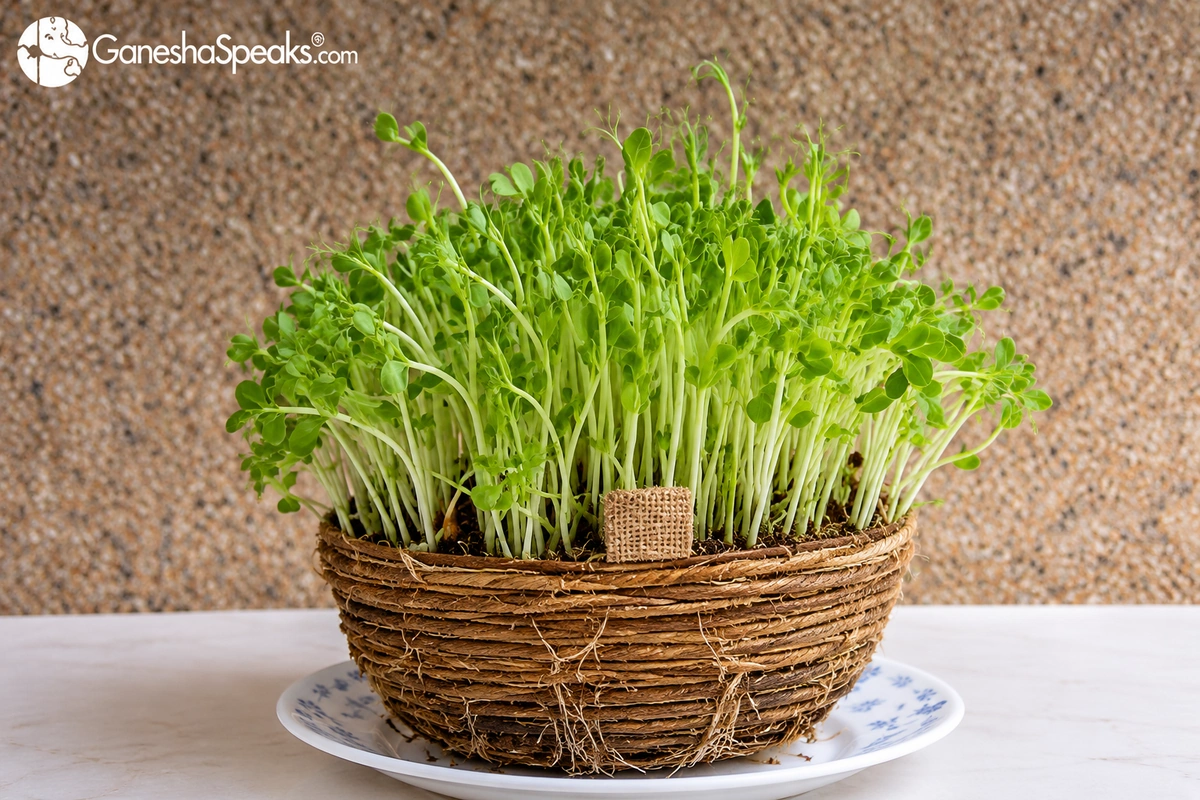
Jware, or barley wheatgrass, is sown on the first day of Navratri during Ghatasthapana, which falls on Sunday, 11 October 2026, and is grown for nine days. It symbolises prosperity, respect for food, gratitude to nature and devotion to Maa Durga. Its growth is traditionally seen as a sign for the year ahead.
Each activity during Navratri has a meaning behind it, which is not obvious. Putting the Akhand Jyot on, setting up the Kalash and worshipping Maa Durga is something we are used to doing. A practice that is witnessed in many houses is the planting of Jware or Barley during Navratri.
Within a few days, tiny shoots begin to show and by the end of the nine days, the little shoots grow big significantly. But for the devotee, these do not just serve as a decorative matter in the Puja area, but are taken as signs of the year’s prosperity – their color, strength and shape hold significance.
Shardiya Navratri 2026 Calendar: Dates, Goddesses and Colours
| Day | Date | Tithi | Goddess | Colour |
|---|---|---|---|---|
| Day 1 | Sunday, 11 Oct 2026 | Pratipada (Ghatasthapana) | Maa Shailputri | Orange |
| Day 2 | Monday, 12 Oct 2026 | Dwitiya | Maa Brahmacharini | White |
| Day 3 | Tuesday, 13 Oct 2026 | Tritiya | Maa Chandraghanta | Red |
| Day 4 | Wednesday, 14 Oct 2026 | Chaturthi | Maa Kushmanda | Royal Blue |
| Day 5 | Thursday, 15 Oct 2026 | Panchami | Maa Skandamata | Yellow |
| Day 6 | Friday, 16 Oct 2026 | Shashthi | Maa Katyayani | Green |
| Day 7 | Saturday, 17 Oct 2026 | Saptami (Maha Saptami) | Maa Kaalratri | Grey |
| – | Sunday, 18 Oct 2026 | Saptami continues; Ashtami begins 08:29 AM | – | – |
| Day 8 | Monday, 19 Oct 2026 | Ashtami (Durga Ashtami) | Maa Mahagauri | Purple |
| Day 9 | Tuesday, 20 Oct 2026 | Navami (Maha Navami) | Maa Siddhidatri | Peacock Green |
| Dussehra | Tuesday, 20 Oct 2026 | Dashami begins 12:51 PM | Vijayadashami | – |
Why Is Barley Sown Alongside the Navratri Kalash?
In Indian tradition, barley is one of the first crops associated with the creation of the universe. It is a wholesome and holy grain. Barley was traditionally used in religious rites and is also offered during Havan and in other sacred ceremonies.
Barley is also planted on the first Navratri when the kalash is kept. The sand/soil is made ready and the seeds are put in it and nurtured during all the nine nights of Navratri.
There is also a simple logic behind it: Food and grain must be shown respect. Life itself, which comes from the earth, is supported by what we harvest. Presenting your crop to the Mother Goddess is a symbol of thankfulness for the nourishment and growing abundance.
When Tiny Jware Shoots Become More Than a Plant
The first shoots typically emerge in two to three days.
The shoots are also traditionally known as Jayanti. According to common folklore, followers look for the outcome of how Jware grows as it is often seen as a symbol of family wealth and possible future scenarios.
This was especially important to understand in terms of its traditional sense. This is based on a religious or cultural belief and is not a scientific way of predicting an outcome.
Navratri 2026 Key Muhurat Timings
| Event | Date & Time (2026) |
|---|---|
| Ghatasthapana Muhurat | Sunday, 11 Oct 2026 – 06:21 AM to 10:14 AM (03 Hrs 53 Mins) |
| Ghatasthapana Abhijit Muhurat | 11:46 AM to 12:33 PM (47 Mins) |
| Pratipada Tithi | 09:21 PM on 10 Oct 2026 to 09:32 PM on 11 Oct 2026 |
| Durga Ashtami Sandhi Puja | Monday, 19 Oct 2026 – 10:29 AM to 11:17 AM |
| Maha Navami (Navami ends) | Tuesday, 20 Oct 2026 – till 12:51 PM |
| Dussehra (Vijayadashami) | Tuesday, 20 Oct 2026 |
Are You Facing any Problems in Life? So, this is the right time to Connect with our Astrologer on Chat and remove your obstacles. First Chat Free!
What Does Healthy and Fast-Growing Jware Indicate?
If the barley grows rapidly and continues to grow well, this is said to be a positive sign by tradition. Good growth is linked to happiness, progress and prosperity.
The colour is also visible. Light-coloured barley has been associated with household wealth.
In case the Jayanti comes out strong, healthy, green and white, it is considered to be very auspicious. It is said that such a plant signifies a good year. After Navratri is over, such holy Jwaras can be preserved in the grain storage of the house.
When Jware Growth Is Considered a Warning
However, not all such signs are regarded as positive. If the barley starts to wither or does not grow well, it is traditionally believed to be a signal that some problem might be on the way.
Each shift in colour may come with its own significance. If the shoots are red rather than their original colour it is believed that there is a sign about disease or the opposition from an enemy which implies this should be handled with caution.
The Two-Colour Jware and What It Traditionally Means
Another interesting interpretation occurs when two different colours show up on the same plant.
When the Jayanti has a yellow bottom and the top is green, the beginning of the year is considered inauspicious, as per traditional beliefs.
The interpretation is different when the colours are the reverse- green at the bottom and yellow on top. In this instance, the year is good early on but problems may arise later in the year.
The observation by Jware is an interesting part of the nine-day worship for such families.
What Can You Do If Your Navratri Jware Shows Unfavourable Signs?
A negative sign in a religious tradition does not always mean devotees should become fearful. The original practice itself offers a spiritual cure centred around Maa Durga.
To overcome the Jware inauspicious effects, devotees should offer their prayer to Maa Durga. They should perform Havan 108 times in accordance with the 10th Tithi while reciting the names of the nine planets, and should recite the Beej Mantra of Maa Durga 1008 times, with 1008 Havan offerings, before tilak and Aarti.
The Deeper Meaning Behind Growing Jware During Navratri
Growing Jware perhaps seems to be the simplest of all Navratri customs, far quieter than the evening Garba and Dandiya celebrations. It however embodies many factors – respect for food, thankfulness towards nature, optimism for prosperity and devotion to Maa Durga.
As the young shoots grow over the nine nights, they provide a reminder of growth and re-generation. For the devotees that celebrate this practice, a healthy Jware is a sign of prosperity and the Mother Goddess’ blessing.
Will 2027 be a year of strength or stress? Get Your Detailed Report Now!
FAQs
What is the significance of growing wheatgrass during Navratri?
Growing wheatgrass during Navratri holds religious importance in Hinduism. It symbolizes the first crop of barley, which is offered to the gods and goddesses during Havan rituals. This practice teaches respect for grains and is believed to predict the future of the grower.
How does the color of wheatgrass indicate your future?
The color of the wheatgrass grown during Navratri can indicate aspects of the grower’s future. A healthy and vibrant green color is often seen as a positive sign, while dull or stunted growth may suggest challenges ahead.
Why is barley considered a complete crop in Hindu rituals?
Barley is considered a complete crop because it was the first crop to be created according to Indian beliefs. It is used in religious rituals such as Havan to honor the gods and goddesses, symbolizing abundance and prosperity.
What are the benefits of wheatgrass according to Ayurveda?
According to Ayurveda, wheatgrass juice is effective in treating sunburn, bad breath, body odor, obesity, blood sugar levels, cancer, and skin issues like pimples and blemishes.
How can one perform Navratri Puja based on their horoscope?
To perform Navratri Puja according to your horoscope, it is recommended to consult expert astrologers who can provide personalized guidance based on your astrological chart.