








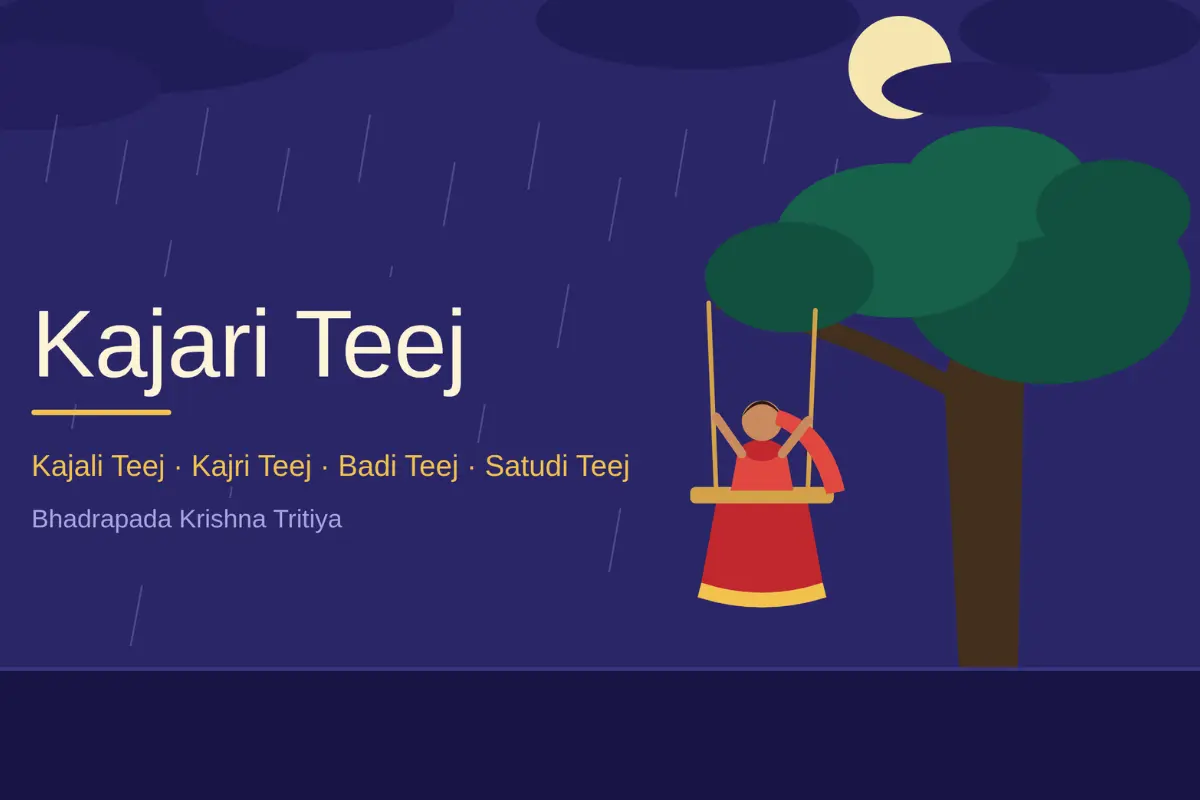
Kajari Teej is a festival where devotion meets the sounds of the monsoon. As women dress up, decorate swings, sing traditional Kajari songs and observe the Teej vrat, the festival brings together prayers for marital well-being with a rich folk culture that has been passed down through generations. Also known as Kajali Teej, Kajri Teej, Badi Teej and Satudi Teej, Kajari Teej is especially popular in Rajasthan, Uttar Pradesh, Madhya Pradesh and Bihar.
In 2026, Kajari Teej will be observed on Monday, August 31. The festival falls on the Tritiya Tithi of Krishna Paksha in the Bhadrapada month according to the North Indian Purnimanta calendar. In the South Indian Amanta calendar, the same day falls in the Krishna Paksha of Shravan.
Kajari Teej 2026 Date and Muhurat
Kajari Teej is celebrated on Krishna Paksha Tritiya and usually includes fasting, prayer and festivities in the evening.
| Particulars | Date & Time |
|---|---|
| Kajari Teej 2026 Date | Monday, August 31, 2026 |
| Tithi | Bhadrapada Krishna Tritiya |
| Tritiya Tithi Begins | August 30, 2026, at around 9:36 AM |
| Tritiya Tithi Ends | August 31, 2026, at around 8:50 AM |
| Moonrise for Chandra Arghya | August 31, 2026, 8:36 PM |
The timing of Tritiya often confuses many devotees. Tritiya is believed to end at 8:50 AM on August 31, which may create doubt about the correct fasting date. However, as this vrat follows the udaya tithi rule, the tithi prevailing at sunrise is taken into consideration. Since Tritiya remains in effect at sunrise on August 31, the vrat will be observed on this day.
The timings for the festival can vary slightly depending on the geographical area. People involved with Kajari Teej celebration must check their regional Panchang to know the celebrations for Kajari Teej.
The Kajari Teej festival happens around a fortnight after the celebration of Hariyali Teej and Hartalika Teej is celebrated after that. There are instances when people refer to Kajari Teej as Badi Teej and call Hariyali Teej Chhoti Teej.
If You Want to Know About the Various Areas of Your Life in 2026 Read the 2026 Detailed Report..
What Is Kajari Teej?
Kajari Teej is a Hindu festival that celebrates devotion to Goddess Parvati and Lord Shiva. The festival is observed by married women who pray for the long life and health of their husbands. Even unmarried girls observe this fast in the hope of getting married to a good husband.
The festival is celebrated across Rajasthan, eastern Uttar Pradesh, Bundelkhand, Madhya Pradesh, Bihar, and parts of Haryana. Unlike most other festivals that focus more on religious rituals, Kajari Teej has strong links with folk songs, gathering of women and other rainy season traditions.
The word traces back to kajal, the kohl used to line the eyes, and by extension to the dark, kohl-coloured monsoon clouds. Kajri is the monsoon song tradition of eastern Uttar Pradesh, sung around Mirzapur and Banaras, and the songs are almost always about absence — the rains have come and the husband has not returned. A second, less common tradition holds that Kajali was the name of a dense forest in Central India.
Why Is Kajari Teej Celebrated?
Kajari Teej’s principal religious concept centers on the value of faithful wives and the graces of Goddess Parvati. Women pray for them to provide stability and happiness in marriage to both them and their families.
In many areas, women also worship Neemdi Mata or Neem Mata and thus connect the festival with the neem tree. The neem tree historically has great cultural and religious significance in Indian culture, which gives Kajari Teej a unique character. The belief is that Shiva and Parvati rested beneath a neem tree after their marriage. Where this is practised, a neem branch is planted upright and worshipped as the goddess herself, bathed with water and offered roli, rice, flowers and sindoor, often beside a small clay pond or a bowl of milk and water.
Moreover, the festival carries a strong message of unity. Women come together with their relatives and friends, sing Kajari songs and participate in the celebrations thus making the vrat a communal ritual instead of being a religious one.
Kajari Teej Vrat and Puja Vidhi
The exact rituals differ by region and family tradition, but the main observances generally include:
The vrat is observed from sunrise to moonrise and is traditionally nirjala which means without food or water for the whole time. Practice varies, and many women today keep a modified fast with water or fruit, particularly if they are pregnant, unwell, elderly or on medication.
1. Morning Bath and Sankalp
At the start of the day, women participating in the vrat bathe and get dressed in clean clothes. They then make a Sankalp to keep the vrat and pray to Goddess Parvati and Lord Shiva.
2. Prepare the Puja Space
A clean area is arranged for the puja. According to the local tradition, the photographs and idol statues of Lord Shiva and Goddess Parvati are put in a place for worship. Some communities worship Neem Mata too during their celebrations of the Kajari Teej.
3. Offerings and Puja
In the puja, items such as water, flowers, fruits and sweets are utilized in worshipping the gods. The women observing the festival pray to Lord Shiva and Goddess Parvati for a good life for their husbands and for a happily married life.
4. Listen to the Vrat Katha
During the observance of this vrat, devotees remember or recite the Kajari Teej vrat katha. Hearing this story helps them understand the religious aspect of keeping the vrat.
5. Kajari Songs and Swings
Traditional Kajari songs form an integral component of the celebration, especially in Uttar Pradesh, Bihar and certain areas of Rajasthan and Madhya Pradesh. Decorated swings may also be constructed in some regions to allow women to have fun along with the folk songs relevant to the season.
6. Moon Worship and Parana
In customs wherein fasting is broken after the Evening Ritual, the women perform Arghya to the Moon as the moon rises, before breaking the fast.
Vrat Katha
The best-known Kajari Teej story is about a poor Brahmin and a bag of sattu.
In a village long ago lived a Brahmin so poor he owned almost nothing. His wife was devout and had never missed a fast. When Kajari Teej came, she reminded him that she was keeping the vrat and needed sattu for the puja, and that no one from her maternal home would be sending any.
He had no money, and evening was closing in. He went out and searched and found nothing, and at last came to a grocer’s shop and slipped inside to take a little sattu. The noise brought out the shopkeeper, a moneylender, who caught him and demanded to know what he had stolen. The Brahmin confessed everything – that he was poor, that his wife was fasting, that he had never meant to become a thief. The shopkeeper had his servant check, and found the man was carrying sattu and nothing else.
The moon had risen by then. The moneylender understood what he was looking at: a man who had risked disgrace so his wife could keep her fast. He told the Brahmin that from that moment he would regard the Brahmin’s wife as his own sister, and sent him home not only with the sattu but with new clothes, ornaments, kajal, mehndi and money. The Brahmin returned, his wife completed her puja, offered arghya to the moon and broke her fast — and the household never knew that kind of want again.
This katha is folk literature rather than scripture. Kajari Teej has no Puranic story of its own; the tales told at the vrat travel by word of mouth and by printed pamphlet, which is why your family’s version may differ. The scriptural story underneath all three Teej festivals is Parvati’s penance to win Shiva, told in the Shiva Purana’s Rudra Samhita.
Kajari Teej Significance
Kajari Teej is distinct in its blend of religious faith and local culture. The fast fulfills the promise of faith and fidelity along with the prayers for one’s family, while folk songs and festivities add historical importance to the festival due to the significance of North Indian folk traditions.
The association with rain is equally important. The impact of rain on the environment is captured in the various Kajari songs as it is deeply linked with the mood of the season. For this reason, the festival is famous for its songs and gatherings in addition to the rituals that one performs.
Kajari Teej is also indicative of the importance of women’s gathering. Families and friends, along with women after their marriage connect during this festival.
Kajli Teej Mela in Bundi, Rajasthan
In Bundi, the Kajari Teej Mela is held every year. During the festival, an idol of the goddess is taken through the old town in a procession, with folk musicians and dancers, along with camels and elephants.
Kajari Teej 2026: What Makes This Year Special?
In the year 2026, Kajari Teej will be celebrated on Monday, which only symbolizes the festival’s close association with Lord Shiva. This observance occurs three days after Raksha Bandhan, and five days before Janmashtami, thus keeping it in a busy festive time for the Hindus.
This is why this day is great for the followers to fast and celebrate with their friends and family members.
Kajari Teej 2026: A Festival of Faith, Folk Culture and Togetherness
Kajari Teej is not only a day of fasting but a celebration of many facets of devotion to God, marriage and family relationships, monsoon traditions and folk culture. The celebrations of Kajari Teej will involve worshiping Goddess Parvati and Lord Shiva, singing and dancing the Kajari songs.
Irrespective of whether one is fasting in order to be happy in a marriage or observe the festival just for the sake of being linked with the traditions that have come down from the past, Kajari Teej offers excellent opportunities for the devotees to stop and enjoy the festive season.
In 2026, celebrate Kajari Teej according to local customs and your family’s tradition, and enjoy this wonderful festival, which has its roots reaching back in time.
Attract Good Luck With Your Personalised Horoscope On The Auspicious Day Of Bagalamukhi Jayanti – Talk To An Astrologer Now. Get First Consultation Free
FAQs
When is Kajari Teej celebrated in 2026?
Kajari Teej in 2026 will be observed on Monday, August 31. The festival falls on the Tritiya Tithi of Krishna Paksha in the Bhadrapada month according to the North Indian Purnimanta calendar.
What is the significance of Kajari Teej?
Kajari Teej is a Hindu festival that celebrates devotion to Goddess Parvati and Lord Shiva. It is observed by married women who pray for the long life and health of their husbands. The festival also involves singing traditional Kajari songs and celebrating the monsoon season.
What are the main rituals of Kajari Teej?
The main rituals of Kajari Teej include fasting from sunrise to moonrise, prayer, singing traditional songs, and worshipping the neem tree. Women often gather to sing Kajari songs and pray for marital well-being.
How is the date for Kajari Teej determined?
Kajari Teej is celebrated on Krishna Paksha Tritiya. The date is determined by the tithi prevailing at sunrise, following the udaya tithi rule. In 2026, Tritiya ends at 8:50 AM on August 31, so the festival is observed on this day.
Where is Kajari Teej predominantly celebrated?
Kajari Teej is predominantly celebrated in Rajasthan, Uttar Pradesh, Madhya Pradesh, Bihar, and parts of Haryana. It is a festival that combines religious practices with rich folk traditions.