





Nakshatra – Stars in Astrology, Nakshatra Astrology, Nakshatra Horoscope
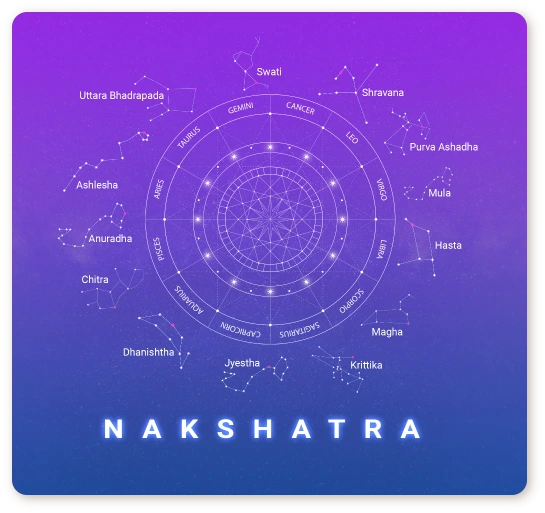
The Ancient Hindu Sages divided the zodiac into 27 Nakshatras or lunar constellations. Each constellation covers 13 degrees, 20 minutes. The calculation of Nakshatras starts with Ashwini Nakshatra at 0 degrees of Aries. Revati Nakshatra covers 30 degrees of Pisces. Abhijit is the 28th Nakshatra. The use of Nakshatra is very important in Vedic astrology. The Vimshottari Dasha is based upon the birth of Nakshatra, which is a 120-year-long planetary cycle. Each Nakshatra is divided into four sections called Padas. Nakshatras also define the characteristics of the planets placed in them. Knowing Janma Nakshatra is very important, as per Vedic astrology. Janmanakshatra is the Nakshatra in which the Moon was placed at the time of birth. The Moon travels through a Nakshatra in a day.
Know Your Nakshatra Gana and Their Characteristics Know Your Nakshatra Gana and Their Characteristics – How Gana Influence in Human Behaviour.

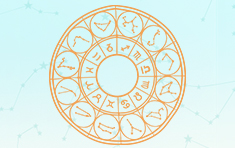


The 28 Nakshatras in Vedic astrology are –


Get Your First Call or Chat FREE with Our Expert Astrologers – Consult Now!
View All









The Significance of Nakshatra in Astrology
Categorize Of Nakshatras
We categorize the Nakshatras into three groups: divine, human, and demonic. Gender and Varna (caste) divide people. They have assigned qualities, such as colour, deity, and rulership. When studying how a planet affects a sign, look at where it is in relation to Nakshatra and Pada. Indians have used Nakshatras for centuries to pick fortunate dates and times for events, such as weddings. The role of Nakshatras and their respective Padas in predictive astrology is unique to Indian Vedic astrology.
Nakshatra or Stars in Astrology
These celestial luminaries make all the difference in astrological calculations. Initially, the zodiac was grouped in 12 Rashis for convenience, however the ancient seers have farther subdivided the heavens into 27 Nakshatras or star constellations for the call of precession. These constellations or the Nakshatras emerged as one of the most important components in Astrology.
Vedic astrology identifies each constellation with a star. The 360 degree division of the sky is therefore further divided into 27 subdivision of 13.20 degrees identified with 27 stars. Each of these Nakshatras are farther subdivided into four Padas or quarters of 3 degrees and 20 minutes.
Therefore the first Rashi, Mesha, which has 30 degrees, contains the entire 4 Padas (13:20′) of the 1st star constellation Ashwini, the entire 4 Padas (13:20′) of the 2nd star constellation Bharani and the 1st Pada (3:20′) of the third star constellation Krittika. In this manner, each Rashi comprises of 9 Padas. Some schools of astrology also consider 28 divisions with an additional star called Abhijit. However, for all practical purposes only 27 stars starting from Ashwini are considered. (Ref: the chart).

2026 Horoscope Predictions
These horoscope predictions are based on your zodiac sign. Get better understanding of Your Year Ahead.


Aries Horoscope 2026
When the year 2026 When the year 2026 When the…
Taurus Horoscope 2026
When the year 2026 When the year 2026 When the…

Gemini Horoscope 2026
When the year 2026 When the year 2026 When the…

Cancer Horoscope 2026
When the year 2026 When the year 2026 When the…

Leo Horoscope 2026
When the year 2026 When the year 2026 When the…

Virgo Horoscope 2026
When the year 2026 When the year 2026 When the…

Libra Horoscope 2026
When the year 2026 When the year 2026 When the…

Scorpio Horoscope 2026
When the year 2026 When the year 2026 When the…






March 2026

3 March
Holi – The Festival of Colours and Its Significance
Holi – The Festival of Colours and Its Significance There are innumerable festivals and …
10 March
Date, Timing, Significance, and Rituals of Sheetala Saptami in 2026
Date, Timing, Significance, and Rituals of Sheetala Saptami in 2026 There are innumerable festivals and …
15 March
Fasting on Papamochani Ekadashi Absolves All Your Sins
Fasting on Papamochani Ekadashi Absolves All Your Sins There are innumerable festivals and …


Rani Mukerji Horoscope 2026: The Astrology Behind Mardani 3 & Her Fierce Comeback
Over more than twenty years, Rani Mukherjee hasn’t just stayed relevant; she’s thrived! She did powerful roles in both romantic…
Kangana Ranaut Horoscope 2026: From “Queen” Controversies to a Power Peak – What’s Next?
Did you know? Kangana Ranaut, from a small village in Himachal, once lived in Mumbai on bread and tea for…
Alia Bhatt Horoscope 2026: From Star Kid to Global Star – Will Alpha Be Her Next Big Hit?
Did you know Alia Bhatt gave her Bollywood debut in Student of the Year when she was just 19 years…
Uday Kotak Horoscope Analysis 2026: From $80,000 to a $50 Billion Banking Empire
Did you know that Uday Suresh Kotak, now a banking legend, started his journey in 1985 with just $80,000 borrowed…
Ibrahim Traoré Birth Chart Analysis: Astrology Behind Africa’s Youngest President’s Rise to Power
Did you know that Ibrahim Traoré, the youngest president of Burkina Faso, Africa, has made a unique gesture of replacing…
Aamir Khan Horoscope 2026: Why He Avoids Award Shows & Will Lahore 1947 Turn Into a Major Hit?
Aamir Khan has a superstitious belief that has changed Bollywood’s history as we know it today. Since losing the Best…
Jamie Dimon Journey: Fired from Citigroup to Building a $4 Trillion Financial Empire
Ever heard of James Dimon, popularly known as Jamie Dimon? You might not know, though, that the man who today…
Ind vs NZ Final Match Prediction: New Zealand’s First Ever T20 World Cup Title vs India’s Back-to-Back Dream
India vs New Zealand – Destiny or Déjà Vu? March 8.Ahmedabad. One stadium.One trophy.Two nations staring at cricket destiny. And…
Today’s Panchang View All
17 March 2026
- Mumbai, India
- Sunrise : 06:44
- Sunset : 18:49
- Tithi : Krishna Paksha Trayodashi
- Nakshatra : Dhanistha
FAQs
What are Nakshatras in Vedic astrology?
Nakshatras are 27 lunar constellations that the ancient Hindu sages divided the zodiac into. Each Nakshatra covers 13 degrees, 20 minutes, and they are crucial in Vedic astrology for determining planetary positions and characteristics.
Why is Janma Nakshatra important in Vedic astrology?
Janma Nakshatra is the Nakshatra where the Moon was positioned at the time of a person’s birth. It plays a significant role in Vedic astrology as it influences an individual’s personality and life events through the Vimshottari Dasha, a 120-year planetary cycle.
How is the Vimshottari Dasha related to Nakshatras?
The Vimshottari Dasha is a 120-year-long planetary cycle used in Vedic astrology, based on the birth Nakshatra. It helps astrologers predict significant life events and understand the influence of planets over different periods of a person’s life.
What is the significance of the 28th Nakshatra, Abhijit?
Abhijit is considered the 28th Nakshatra in Vedic astrology, although it is not always included in the primary list of 27. It is a short Nakshatra that falls between Uttarashada and Shravana and is considered auspicious for starting new ventures.
How do Nakshatras influence human behavior?
Nakshatras influence human behavior by defining characteristics of the planets placed within them. Each Nakshatra has its own set of traits, and the Gana, or type, of a Nakshatra can affect an individual’s personality and interactions with others.